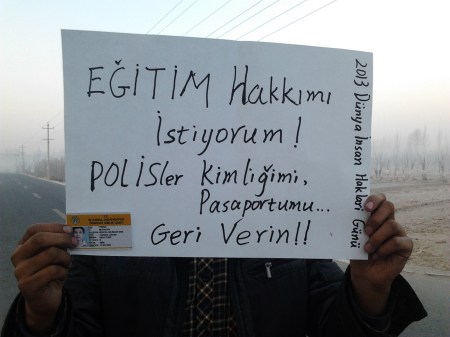
 After the verdict of life in jail against Ilham Tohti 伊力哈木, the Chinese writer Wang Lixiong 王力雄, who published a lot about Xinjiang, said the Chinese government had just created the Chinese Nelson Mandela. Some foreign media gleefully took up this topic, especially when the official Xinhua (New China) agency angrily denounced the suggestion. I remember when Wang Lixiong was discussed on the MCLC list not long ago. There was a zoologist who saw a quote from an essay by Wang Lixiong, maybe in the NY times. The zoologist, who had worked in China, thought Wang was fomenting racial hatred, like certain African American civil rights activists in the 1960s. Actually, Wang had tried to express the desperate anguish among Uighurs and other marginalized people in China. Ilham Tohti just got life in jail for a bunch of isolated quotes like that one from Wang Lixiong.
 The struggle for civil rights and life in dignity is always within a particular society, not between countries or hemispheres. The workers in the brick kilns of Vienna’s 10th district, where we now live, were championed by Victor Adler, physician, psychiatrist and founding organizer of the Social Democrats. The great strike of 1895 resulted in one dead worker and many wounded, but also eventually in a big turn-around in conditions through a widened conscience and consciousness in the middle class. Wanting to catch up with a supposedly more progressive society or country or hemisphere helps a lot, of course. There is something like international conscience. China’s famous anarchist novelist Ba Jin protested against the death penalties for Sacco and Vanzetti, while he was in France. Many Chinese working students went to France as part of China’s engagement in the First World War. Deng Xiaoping was among them. Ba Jin 巴金, who took his pen name from the transliterations of Bakunin and Kropotkin, lived until 2005. I visited his house in Shanghai in December, it is a museum now. Ba Jin was very, very lucky to live for almost 100 years, although he was also “struggled against”. In the 1980s and 1990s, he argued for a museum about the atrocities of the 1960s. But after 1989, there was and is no hope for that kind of thing, except in small private efforts. Where did Ba Jin get his Anarchism? Were Bakunin and Kropotkin translated from Russian or from Japanese? Communism was imported into China via Japan, Prof. Qin Hui 秦晖 argued in Vienna in July at a China and First World War symposium. Along with nationalism, and the result was a radically Stalinist brand, eventually. There are complicated international economic and political implications, then and now. But still, developments in worker’s and citizens actual conditions and rights are the result of a struggle for conscience and consciousness in a particular society. Rights do not come from the barrel of a gun. When a government disappears students to frame them with the supposed crimes they did for their teacher, so they can be made to frame their teacher, and these disappeared students suddenly appear on TV, shackled in orange uniforms through prison bars, after their parents have looked for them for half a year or more, not knowing if they are still alive, and when professors from other universities declare that since it has been proven through these students and from clearly oppositional statements of the accused teacher in class and from students and other authors on a website he founded that he incites racial hatred, it is clear beyond doubt he has to be put away for life, because no society in the world would or should tolerate incitement for racial hatred after what happened to the Jews in the Second World War and so on – if Uighur students are disappeared just like that and suddenly paraded on TV and no-one asks what they are really accused of or if they were tortured, no-one asks how many months they and their teacher spent shackled in leg irons, no one asks if the government would dare to do that to Han Chinese students and professors – what am I getting at? There is a big lack of conscience and consciousness, a lot of repression. Again, this is a struggle within a particular society.

My translation of Liu Zhenyun’s 刘震云 “1942“ (温故一九四二)is coming out in German these days. With biting sarcasm, Liu describes the loneliness at the very top. At summit meetings, those statesmen often shake each other very warmly by the hand, or even hug and kiss each other. That’s because they are class brothers, says Liu’s narrator. They might be lonely, because nobody understands them. They would like to care for ordinary people, only there are always more pressing concerns. But they can still rest at ease, because no matter what happens, even if millions are being killed by famine and war, everyone else will be affected before them, they will always be most well protected.
The loneliness of a man or a woman who has lost everything is a very different situation from that of a government leader. Liu Zhenyun describes both in harrowing details. I asked Chen Xiwo 陈希我, the celebrated novelist whose works are banned in China, how he would compare Liu Zhenyun’s “1942“, originally written 1992-1993, to other important realist works in the 1980s and 1990s. If you compare it to Zhang Wei’s Old Ship 古船 from 1985 and Chen Zhongshi’s White Deer Plain 白鹿原 from 1993, Chen Xiwo said, the political analysis in “1942“ is the best.
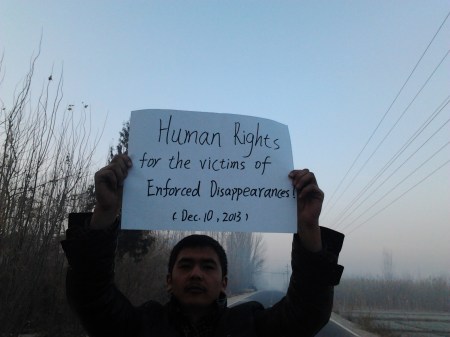
The NY Times article about the students paraded on Chinese TV to denounce their teacher Ilham Tohti has a link to a blog by a student who was also disappeared and made to denounce Ilham, but then he was released late last year. It is a moving piece.

 中国大好き
中国大好き 