1月 25, 2025
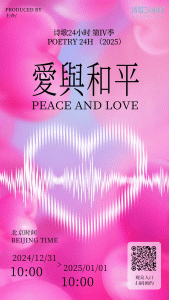
POETRY READING from December 31st till January 1st
Peace and Love poetry reading (1)
January 18, 2025
On December 31, I participated in a New Year’s Eve and New Year’s Day poetry marathon on the internet in Chinese and other languages, hosted by the poet 桉予 An Yu. Altogether 300 poets reading over 24 hours. One section was devoted to poets from Ukraine. An Yu has now been circulating video recordings of readings from this section on WeChat, under the title Real Tiktok Refugees. I have seen reports from Ukraine and even online anthologies of poetry from Ukraine censored on WeChat, but for now, these voices are there to be heard and seen. It is a diverse selection, maybe as diverse as possible in this situation.
Real TikTok refugees – Ukrainian section of New Year poetry readings on the Chinese internet: Introduction and nine poets reading their works, along with translations.
https://mp.weixin.qq.com/s/ifq5ZTOPY7c0d4eemiJr7g
Real TikTok refugees, part 2: Ten more poets reading their works, along with translations
https://mp.weixin.qq.com/s/jG7IN-2rH-nkApXSW4FGeg
Martin Winter 维马丁



标签:An Yu, MCLC, meeting, people, poetry, poets, reading, reciting, refugees, Ukraine, war, world, writing, 桉予
发表在 1950s, 1960s, 1970s, 1980s, 1990s, 19th century, 2000s, 2010s, 2014, 2020s, 2022, 2023, 2024, 2025, 20th century, 21st century, December 2024, January 2025, Middle Ages, poetry, Translations | Leave a Comment »
2月 27, 2024
Dear poetry fans,
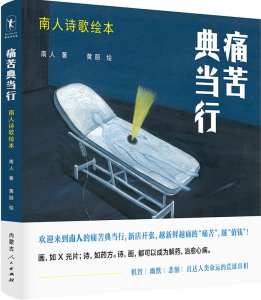
On Febr. 10, the Frankfurter Allgemeine Zeitung published my article on the poet Nan Ren 南人 (scroll to p. 5; there are a few minor mistakes in the German article, I couldn’t see the final print version before it came out: the first poem has one line added; and Shaanxi became Shanxi). Last week I decided to write a version in English for the MCLC Resource Center.
This is a newspaper article, so there are no footnotes. The reference to Maghiel van Crevel was not included in the German print version. I have thought about many names of poets I should have mentioned, and other things I should have said. Anyway, such a publication in a major daily in Germany is a big success, a big deal in international exposure for current Chinese poetry. I hope you like it. Please comment, thank you!
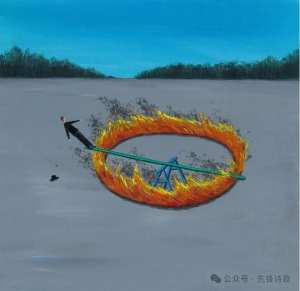
Sources: Here is a link to the poems in the article including the original Chinese versions. And here are some of the paintings by Huang Li 黄丽 that accompany the poems in the book. The pictures look much better in the book. Nan Ren has sent them to me in high resolution. He and Xiron have authorized me to look for publishers in Europe and beyond. I hope to find publishers for the German speaking and for the English speaking Pawnshop. Here is a link to about 50 poems in Chinese with some translations in English or German. Here is a link to the announcement from last May, when the book was published in China. The publisher is Xiron Poetry Club, 磨铁读诗会. Xiron is a big publisher, led by the poet Shen Haobo 沈浩波. But Xiron is private and has to purchase an ISBN for each book from a state publisher. The state publisher is on the cover, Xiron Poetry Club is on the first page. Both have to avoid publishing anything that could get the book pulled or forbidden.
IN A PAWNSHOP OF PAIN
Nan Ren is a legend. He doesn’t like to say when he was born. 1970, found that somewhere. Not important. Nan Ren is a pen name. The nán of ‘south‘ and the rén of ‘person‘. What does that mean? His family comes from the south, somewhere south of the Long River, the Yangtse. Nanren, southern people, was the lowest stratum in the Mongol empire. The Mongols captured the south last, all the better jobs had been assigned to other people already. Almost every poet writing in Chinese has a pen name. People have more than one name in Chinese, even non-artists. It was that way in Confucius‘ times. And in the occident, people also had several names, at least prominent people, all the way from Homer.
More …
标签:beijing, book, books, censorship, 磨铁, 磨铁读诗会, Democracy Wall, disease, Europe, 西毒何殇, Fang Miaohong, FAZ, frankfurt, Germany, history, internet, Maghiel van Crevel, MCLC, media, memory, name, names, Nan Ren, newspaper, opera, pandemic, people, poetry, publishing, reality, self censorship, Shen Haobo, singing, society, time, wall, walls, writing, Xi'an, Xidu Heshang, Zhu Jian, 南人, 尹丽川, 方妙红, 朱剑, 椿树, 沈浩波
发表在 11th century, 13th century, 14th century, 15th century, 16th century, 17th century, 18th century, 1900s, 1910s, 1920s, 1930s, 1940s, 1950s, 1960s, 1970s, 1980s, 1990s, 19th century, 2000s, 2010s, 2020s, 2023, 2024, 20th century, 21st century, April 2023, February 2024, May 2023, Middle Ages, poetry, Song Dynasty, Translations | Leave a Comment »
6月 4, 2016

Calligraphy by Chen Shih-hsian
IS THERE A GOOD WAY TO (TRANSLATE) POETRY?
Is there a way?
Is there a good way?
Is there a good way to poetry?
Is there a good way to translate poetry?
Why not?
Depends on the poetry.
The source poetry,
the target poetry.
The audience
and the massacre.
Maghiel van Crevel’s translation
of Han Dong’s Big Wild Goose Pagoda
is perfect.
Both pagodas are perfect.
Maybe the small one
retains more of the flavor
of Xi’an 20 or 30 years ago.
Haven’t been to the small one in many years.
Nicky Harman’s translation quoted by Xujun Eberlein
in the LA Review of Books
should have no quite in my opinion
only quiet.
Otherwise it is perfect.
Is there a good way to translate poetry?
Into what?
Mashed potatoes?
If I’m not a poet
in target poetry
– how many shots for a dollar?
If the person in charge
doesn’t produce competent targets
why do they buy them?
Is there a way?
Is there a good way to poetry?
Depends on the poetry.
The source poetry, the target poetry.
The audience and the massacre.
June 3rd, 2016
P.S.: Pls refer to Shen Haobo’s REPUBLIC. Maybe his best poem. Maybe my best translation.
Thank you,
Martin
标签:1989, audience, big, dependance, 韩东, good, Han Dong, history, Maghiel van Crevel, massacre, MCLC, memory, Nicky Harman, pagoda, people, perfect, poetry, potatoes, quiet, Shen Haobo, small, sources, targets, time, translation, way, Xi'an, Xujun Eberlein, 沈浩波
发表在 1989, June 2016, poetry, Translations, Uncategorized | Leave a Comment »
 中国大好き
中国大好き 