Posts Tagged ‘cruelty’
12月 23, 2024
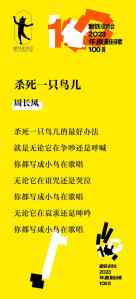
Zhou Changfeng
TO KILL A BIRD
The best way to kill a bird,
no matter if it cries out or resists,
you just write down, a little bird sings.
No matter if it curses or weeps,
you only write, the little bird sings.
No matter if it begs or moans,
you write, a little bird sings.
2023
Translated by Martin Winter, December 2024
磨铁诗歌奖·2023年度最佳诗歌100首|周长风《杀死一只鸟儿》入选理由:诗里的意思好,写得聪明灵巧。在重复叠加的隐喻中,传递出强烈的批判性。诗人有态度,有愤怒,有批判,但却不是扯着嗓子喊出来,而是用如此生动的方式,写得发人深省。(磨铁读诗会/沈浩波)
Xiron Poetry Club
标签:animals, bird, creativity, cruelty, 磨铁读诗会, description, expression, history, killing, memory, method, methods, rape, record, recording, records, singing, song, sounds, war, way, ways, words, writing, Zhou Changfeng, 周长风
发表在 1950s, 1960s, 1970s, 1980s, 1990s, 2000s, 2010s, 2020s, 2023, 2024, 20th century, 21st century, December 2024, Middle Ages, poetry, Translations, 沈浩波 | Leave a Comment »
10月 22, 2024
磨铁读诗会 Xiron Poetry Club
Shen Haobo
GRILLEN
Diese paar Kerle
fangen von einer Pappel
am Wassergraben
eine zirpende Grille.
Sie reißen der Grille
die Flügel aus,
ohne die Flügel
ist die Grille
nur ein Stück Fleisch.
Also zieht
einer der Kerle
sein Feuerzeug
fängt an die Grille
am Hintern zu grillen.
Bald riecht man
das Fleisch.
Übersetzt von MW im Oktober 2024

蝉
沈浩波
那几个家伙
从引水渠旁的杨树上
捉下一只
鸣叫的蝉
他们撕掉
蝉的翅膀
当翅膀被撕掉
蝉就只是
一块肉
果然
其中一个家伙
掏出打火机
在它的屁股下
烤
不一会儿
就传来肉香
标签:animals, brutality, cruelty, expression, meat, people, poetry, scene, scent, Shen Haobo, smell, sound, sounds, writing, 沈浩波
发表在 1960s, 1970s, 1980s, 1990s, 2000s, 2010s, 2020s, 2024, 20th century, 21st century, Middle Ages, October 2024, poetry, Translations, 沈浩波 | Leave a Comment »
8月 15, 2023

Picture via WeChat
Shen Haobo
EACH CAT WILL BECOME HUMAN
Each person who walks in the night like a cat,
arching their back towards the end of their days.
Each one whose hands are as soft as a cat’s paws inside.
Each person who’s eating their heart out.
Each one who doesn’t care if cats are black or white
as long as they catch mice.
Each one in love with the deep eyes of a cat.
Each person whose heart is torn by a cat’s claws.
After one hot summer night
they will all be enchanted
so they become cats.
Each human all over the earth
becomes a big cat, a small cat, an old cat,
a black cat, a grey cat, a white cat, a brown cat, a striped cat.
Everything tamed becomes cruel.
Every softness evolves into hate.
Every cat will become human.
5/11/13
Translated by MW in August 2023

所有的猫都将变成人
沈浩波
所有深夜走猫步的人
猫着腰俯冲向岁月终点的人
手掌像猫的脚垫一样温柔的人
醉心于撕咬的人
不管白猫黑猫抓到老鼠就是好猫的人
沉迷于猫的幽深目光的人
被猫的爪子挠伤内心的人
在一个燥热的夏日午后
都会被施加魔法
统统变成猫
地球上所有人全部变成猫
大猫、小猫、老猫
黑猫、灰猫、白猫、黄猫、花猫
所有的温顺都将变成残忍
所有的柔软都进化为仇恨
所有的猫都将变成人
2013/5/11

标签:animals, cruelty, people, poetry, Shen Haobo, society, 沈浩波
发表在 1970s, 1980s, 1990s, 19th century, 2000s, 2010s, 2013, 2020s, 2023, 20th century, 21st century, August 2023, May 2013, Middle Ages, poetry, Prehistoric times, Translations, 沈浩波 | Leave a Comment »
4月 29, 2022
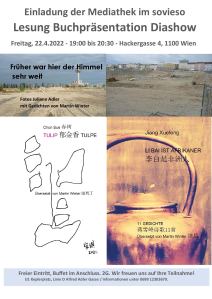
Jiang Xuefeng
ICH WEISS
Manche können es gar nicht erwarten,
anderen die Tür zu versiegeln.
Manche verbieten anderen zu pflügen,
verbannen das Rind und den Menschen dazu.
Manche verprügeln alte Leute auf ihrem Spaziergang im Hof.
Manche schnappen ein Ehepaar auf dem Weg ins Spital.
Manche kaufen mit Lebensmitteln in isolierten Höfen
die Körper von Frauen.
Andere verkaufen Passierscheine.
Manche isolieren infizierte Bewohner
von ihren Kindern,
verweigern Versorgung und Medizin bis zum Tod.
Manche verkaufen Tofu so teuer wie Fleisch.
Manche ziehen weiße Kittel an
wie die Parteiuniform der Armee.
Sie sind die Übermenschen
in Macht im Glück,
die anderen sind Juden.
Diese Leute versündigen sich
und handeln im öffentlichen Auftrag.
Da und dort bis zum Himmel sind noch viele Leute,
die können es gar nicht erwarten
“zu helfen”.
Ich weiß!
2022-04-28
Übersetzt von MW am 29. April 2022
我知道/蒋雪峰
有的人迫不及待
去封别人的门
有的人不准别人耕地
连牛带人一起驱逐
有的人在殴打在小区散步的老人
有的人在抓去医病的夫妻
有的人在利用食物
换取被封闭小区女人的肉体
有的人在贩卖通行证
有的人把患病的居民
和子女隔离
断粮断药至死
有的人在把豆腐涨成肉价
有的人穿着大白
如同穿上了党卫军制服
作威作福
把所有人
都当犹太人
这些人明明在作孽
却是在执行公务
身边天边还有很多人
跃跃欲试
等着去“帮助”别人
我知道
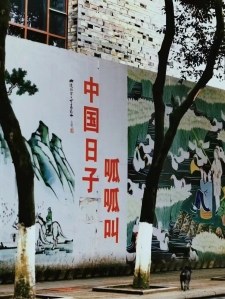
2022.4.28(图片借自亨利)
(Bild von Henry)
蒋雪峰四月诗 Gedichte vom April
https://mp.weixin.qq.com/s/auyGQhAzIKSO0tKmEWwFsQ
标签:control, cruelty, death, disease, 蒋雪峰, family, food, Jiang Xuefeng, knowledge, life, pandemic, people, poetry, politics, society, state, virus
发表在 1950s, 1960s, 1970s, 1980s, 1990s, 2000s, 2010s, 2020, 2020s, 2021, 2022, 20th century, 21st century, April 2022, Middle Ages, poetry, Translations, 新世纪诗典 | 5 Comments »
10月 24, 2019
Cong Rong
ANTI-JAPANISCHER KRIEG
Oma flüchtet,
lässt Song-Porzellan und Jade zurück,
hat meinen Onkel in ihrer Hand.
Die Flüchtlinge drängen sich oben am Berg,
halten den Atem an.
Jemand steckt den Kopf raus und fragt:
Was ist wenn das Kind weint?
Die ganze Gruppe will Oma und das Kind weghaben.
“Wenn es weint, drück ich es tot,
eure Sicherheit ist nicht in Gefahr!”
Sechzig Jahre später frag ich sie,
und wenn der Onkel geweint hätt?
“Dann hätt ich ihn totdrücken müssen.”
Übersetzt von MW im Oktober 2019

抗日战争
从容
外婆逃难,
丢下宋瓷和玉器
手里抱着二舅,
难民们挤在山上
都屏住呼吸
有人挑头说:
这孩子哭了怎么办?
全体都想把外婆和孩子撵走
外婆说:如果他哭,我就地把他掐死,
绝不会影响你们的安全!
六十年后我问她,
如果二舅真的哭了呢?
她说:那我只能掐死孩子。
标签:children, collective, confession, Cong Rong, cruelty, crying, danger, death, family, grandmother, group, history, killing, language, memory, NPC, people, poetry, talk, translation, uncle, war, 從容, 新世纪詩典, 从容
发表在 1930s, 1937, 1938, 1939, 1940s, 1945, 1950s, 1960s, 1970s, 1980s, 1990s, 2000s, 2010s, 2019, 20th century, 21st century, Middle Ages, NPC, October 2019, poetry, Translations, Uncategorized, 新世纪诗典 | Leave a Comment »
5月 29, 2015
Tie Xin
WEANING
these days
the kid
is getting weaned
this means I as the father
have to cooperate
this means time and again
to be firm
to grab him
to pull him away
from his mother’s chest
to ignore
time and again the explosions
of crying
till I get him to sleep
Tr. MW, May 2015
标签:breastfeeding, children, cruelty, crying, explosions, 铁心, father, mother, parents, poetry, sleep, Tie Xin, time, 新世纪诗典
发表在 MAY 2015, poetry, Translations, Uncategorized | Leave a Comment »
1月 7, 2013
Please click on the image

My favourite comments on Mo Yan in the last few months are in the article by Liu Jianmei (刘剑梅), published in FT Chinese on Dec. 11 and posted on the MCLC list on Dec. 19. The title asks something like ‘Does literature still work like a shining light?’ Maybe my translation is not too bright. Should literature be a shining lantern? That’s one of the questions in Liu’s article. Literature and art were thought of as relevant to society and the nation in the 1980s. Liu talks about different approaches and relationships of life and art. Mo Yan deserves careful reading, just like Yan Lianke and Lu Xun. Nothing more or less. Liu uses “Save the cildren”, the last line from Lu Xun’s Diary of a Madman, for a close look into Mo‘s works as well as Yan Lianke’s latest novel Four Books (not published in Mainland China). The main characters of Republic Of Wine and Frogs are unable to save the children, like Lu Xun’s narrator. Republic of Wine features cannibalism and a riotous carnival of language. It’s my favorite among Mo Yan’s novels, along with The Garlic Ballads.
What is art? What is it for? A little more than 100 years ago now, the Dadaists (in voluntary exile in Switzerland and other places) concocted a virtual antidote to the First World War. Words, ordinary and exalted speech, had lost any meaning in the collective carnage. Not much later, Hu Shi, Zhou Zuoren, Lu Xun etc. attempted to change the Chinese language, in written form and on stage. Yomi Braester shows in Witness Against History how Lu Xun’s most famous passages retain ambiguities that belie any straight nationalist reading, even if the author himself would have read them that way. I like the crazed language of the Madman. Republic of Wine, more experimental than any other works by Mo (to my knowledge), goes into that direction. In Bei Dao’s Rose of Time (Shijian de meigui), a collection of essays that appeared in Shouhuo (Harvest) magazine in the early 2000s, when Bei slowly became acceptable in China again, he writes about Pasternak and Mandelstam. In his youth, Pasternak praised Stalin. Later he tried to extricate other writers from the Gulag, with mixed success. Mandelstam believed in Communism all the way to his death in a labor camp. Bei Dao doesn’t say that. But the chapter on Pasternak invokes Russian Formalism and Structuralism that grew out of the abortive 1905 revolution. Art makes reality appear strange and different, enabling the spectator to perceive it more clearly. And the flag of art is always different from the flag on the citadel.
Republic of Wine is wilder than the real Mo Yan on the Nobel stage. When the real Mo (sounds funny, doesn’t it? The real NO, or the real NOT, like NOT A WORD), when the real Mo Yan talked about his mother, I was moved. It sounded like my grandmother in rural Austria around 1920. Sometimes she couldn’t go to school in winter because she had no shoes. But Mo Yan also said his mother was afraid he would “leave the collective” with his storytelling. Qunti 群体, the masses, the collective, could that be called an example of Mao wenti or Mao-ti, Mao-Speak in this usage? Actually not, qunti 群體 is an older word, could have been used by Li Dazho and other founders of the Chinese Communist Party, before Mao, Prof. Weigelin told me recently here in Vienna. She was right, I encountered qunti in another text I liked very much, was it by Yu Hua? Anyway, I was rather baffled when Perry Link related how a mother would tell her child on the bus to “jianchi 堅持”, to hold it until the driver could stop and let the child out to go to take a leak. Would “jianchi” really sound strange outside of Mainland China? But the discussions about Mao-style are still relevant – Mo Yan is an establishment figure nowadays, and generates critique of China’s established system in general.
I was a little surprised when Chinese critics of Mo Yan talked about the carnivalesque language in his novels. As if you had to be careful not to lose yourself in there. I did think of Mikhail Bakhtin and his concept of carnival in Dostoyevsky’s novels when I read Republic of Wine. But as far as I remember, Bakhtin had defended language and storytelling that would sound strange and crazy, as opposed to Socialist Realism. So when was Mo Yan’s writing first associated with carnival? Maybe in the 1980s? And how did this association evolve?
A few days after the recent massacre in a primary school in Connecticut, Ross Douthat in the New York Times talked about Dostoyevsky’s Brothers Karamazov. Although Dostoyevsky was a Christian, Douthat says, the senseless cruelty against children in the novel is just cruelly senseless, there is no “rhetorical justification of God’s goodness”. You have to look at the behaviour of characters who show “Christian love” to find any counterpoint. Below this op-ed, there are 121 reader’s comments, all within one day. Many say they want to talk about guns, not literature.
What is literature for? Why is there a Nobel for literature, but not for music or fine art? Or films? Nobels make for debate. Very much debate, in this case. Great.
标签:children, china, cruelty, literature, media, Nobel prize, politics, religion, theory
发表在 December 2012, January 2013 | 2 Comments »
 中国大好き
中国大好き 