Posts Tagged ‘FAZ’

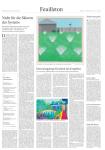
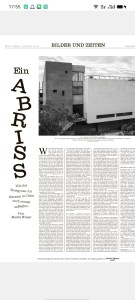
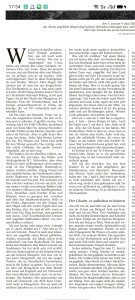
Shangyuan Art Museum in the FAZ

8月 20, 2024

I am in Vienna. From April till late June I was in China, in the countryside near Huairou, northeast of Beijing. I was invited by Shangyuan Art Museum. They built that place from 2003 to 2007. It’s like a sprawling campus. They invited artists there each year, all kinds. Cui Jian, other rock musicians, experimental sound projects. Painting, sculptors, dancing, film, photography, performance. And poetry. That’s where I came in. I was there last year too, in spring and in fall.

They demolished the big exhibition hall in June. The village party committee. In concordance with policy laid down by Winnie the Poo.

It took me a while to write down something a little longer than a poem.

I know it’s rather strange. I wanted to write much more. And I did, in poems in June, when it happened. I miss our community of artists. Being there at that time was living on a different planet. Not just different from Vienna. Different from Beijing, from the village around it, from the mountains. Even very different from being next door in the other places built by artists on the same hill and existing with the same village and party functionaries. It was and is crazy, but it is at the same time a very ordinary situation in China. There is no reason, no feasible reason for the demolition. 没文化, yes. No culture. In the structure of the state, as it comes out here. As it comes out in many places. In sharp contrast to itself, to the image the state also needs to project. Nothing new. Same inherent brutality as ever in the last 100 years maybe. Or more. Playing out in different ways. Not just in China.

I can’t write it like this, not without a lot of context. My poems are more balanced, hopefully. This text, as it has appeared in German, as I can show you in English, is like a long poem. It has to be strange.
信息

你说我提供的

信息不够

我说得看

如果你在

布拉迪斯拉发

在科希策

等等小城

在奥地利

在匈牙利

也许看到

或看不到

也许知道

多少人死

多少人活

四十人走

一个人回

不那个人

他也不在

有新的房子

有纪念碑纪念牌

六十年后

七八十年

中国呢

发生了什么

现在呢

你在的时候

完全不同

感觉不同

有那么多

也那么美

那么作朋友

多时候有

没有人受伤

她一直唱

废墟里唱

山上也唱

没有人受伤

每人都受伤

每人都有

伤痕不同

在的时候

真朋友圈

感觉多好

当外国人

活在异乡

人家都当

当陌生人

我在我国

当陌生人

一直都有

还是不同

2024.8

INFORMATION

You say I don’t give enough information.
It always depends.
If you are there in Bratislava,
In Kosice, in the small towns,
In Austria, in Hungary.
Maybe you see, maybe not.
Maybe you know
how many died, how many survived.
One in forty came back.
No, even those aren’t here.
There are new houses.
There are memorials
sixty years late, seventy, eighty.

What happened in China?
What is happening now?
It’s very different
when you are there.
The feeling is different.
You know you don’t know,
you don’t know most of it.
But there is so much.
So much beauty.

So much companionship,
most of the time.

Nobody was injured,
she sings in her song,
there in the ruins,
up on the mountain.
No one was injured.
Everyone was.
Everyone is
in different ways.

It’s great to be there
among the people
most of the time.
To be a stranger
in a strange land
among many strangers
in their own country.

I am a stranger
in my own country
most of the time.
But I’m not sure,
not like in China.
It is just different.

MW August 2024
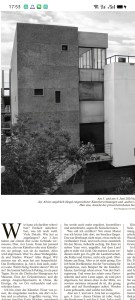

Die FAZ findet es auch seltsam, aber sie bringt es. Es sei zuwenig Information, findet eine Freundin. Ich hab ihr am Telefon und auch persönlich einiges erzählt. Das vermisst sie im Text. Als ich damit fertig war, hab ich auch bemerkt, dass fast nichts über mich drin ist. Auf Englisch noch weniger. Und nix über die anderen KünstlerInnen, fast nix. Sehr gute Bilder und andere Sachen haben sie gemacht. Frauen und Männer, viele sind erst in der Abrisszeit gekommen. Haben einfach so gewohnt wo halt Platz war. Aufgenommen was ging. Ich war mittendrin. wir waren füreinander da. Niemand ist verletzt worden.

Das ist eine Zeile in einem Lied. Ich war dabei, als die Sängerin es in den Ruinen aufgenommen hat. Es klingt fröhlich und harmlos, eine Wanderung auf den Berg, aber der Abriss ist drin. Wieviel da verletzt und zerstört worden ist, wissen wir, die dort waren. Auch andere, die ähnliches erlebt haben. Das sind sehr viele. Praktisch alle, die Kunst machen, und viele andere.
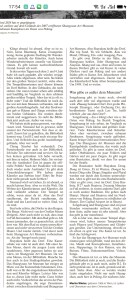
Abgerissen wird aus vielen Gründen. Das Land hat sich sehr schnell entwickelt, bisschen wie Westdeutschland, Österreich und Westeuropa in den fünfziger und sechziger Jahren, aber auch anders. Noch brutaler. Noch mehr kapitalistisch und gleichzeitig diktatorisch mit einer angeblich sozialistischen Partei an der Macht. Pinochet auf angeblich sozialistisch. Nur noch viel größer. Alle Welt macht mit. Profitiert, manchmal. Tut dann wieder besorgt. So kann es doch nicht gehen? Aber das Land ist brutalisiert. Die Leute sind es auch. Vielen geht es besser. Manchen viel besser. Für sie hat es funktioniert. Yi Sha gehört auch dazu. Die Leute wissen, dass der Preis, den manche zahlen, zu hoch ist. Sie wissen, dass vieles passiert, von dem sie lieber nicht sprechen.

Juliane Adler von fabrik.transit kommt aus der DDR. Sie kennt einiges. das Verschweigen besonders. Aber das kennt man und macht man ja bei uns in Österreich immer noch. Ohne Diktatur. Wie soll ich darüber schreiben? Juliane schreibt auch “nur” Gedichte aus ihrem Leben in der DDR. Ich habe viele Gedichte aus der Abrisszeit im Juni und davor. Da ist viel drin an Information. Wer wissen will, wie es in China ist, kann die Gedichte lesen. Viele sind auf meinem Blog. Manche werden in Zeitschriften sein, später in einem Buch. Natürlich würd ich gern mehr in Zeitungen geben. Bin oft zu zaghaft.
Liebe Grüsse!
Martin
IN A PAWNSHOP OF PAIN – On the poet Nan Ren 南人

2月 27, 2024

Dear poetry fans,
On Febr. 10, the Frankfurter Allgemeine Zeitung published my article on the poet Nan Ren 南人 (scroll to p. 5; there are a few minor mistakes in the German article, I couldn’t see the final print version before it came out: the first poem has one line added; and Shaanxi became Shanxi). Last week I decided to write a version in English for the MCLC Resource Center.

This is a newspaper article, so there are no footnotes. The reference to Maghiel van Crevel was not included in the German print version. I have thought about many names of poets I should have mentioned, and other things I should have said. Anyway, such a publication in a major daily in Germany is a big success, a big deal in international exposure for current Chinese poetry. I hope you like it. Please comment, thank you!

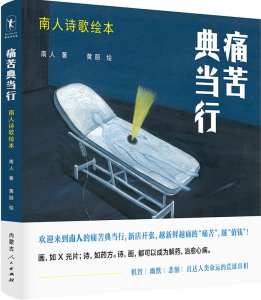
Sources: Here is a link to the poems in the article including the original Chinese versions. And here are some of the paintings by Huang Li 黄丽 that accompany the poems in the book. The pictures look much better in the book. Nan Ren has sent them to me in high resolution. He and Xiron have authorized me to look for publishers in Europe and beyond. I hope to find publishers for the German speaking and for the English speaking Pawnshop. Here is a link to about 50 poems in Chinese with some translations in English or German. Here is a link to the announcement from last May, when the book was published in China. The publisher is Xiron Poetry Club, 磨铁读诗会. Xiron is a big publisher, led by the poet Shen Haobo 沈浩波. But Xiron is private and has to purchase an ISBN for each book from a state publisher. The state publisher is on the cover, Xiron Poetry Club is on the first page. Both have to avoid publishing anything that could get the book pulled or forbidden.


IN A PAWNSHOP OF PAIN

Nan Ren is a legend. He doesn’t like to say when he was born. 1970, found that somewhere. Not important. Nan Ren is a pen name. The nán of ‘south‘ and the rén of ‘person‘. What does that mean? His family comes from the south, somewhere south of the Long River, the Yangtse. Nanren, southern people, was the lowest stratum in the Mongol empire. The Mongols captured the south last, all the better jobs had been assigned to other people already. Almost every poet writing in Chinese has a pen name. People have more than one name in Chinese, even non-artists. It was that way in Confucius‘ times. And in the occident, people also had several names, at least prominent people, all the way from Homer.

More …


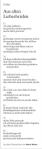
AUS ALTEN LIEBESBRIEFEN – 伊沙 Yi Sha 《當年的情書残片》

2月 14, 2017


489db097jw1f8ipju7k9zj20qo0zkk1e

faz-yi_sha_feb_2017

《当年的情书残片》
伊沙

1. 咱们是
同一战壕里的战友
我亲爱的女同志

2. 在祖国上下一派
莺歌燕舞的大好形势下
你的江山如此多娇
引无数英雄竞折腰

3. 我怀着朴素的阶级感情
怀揣一颗红亮的心
想与你交流交流思想

4. 向毛主席保证
我爱你海枯石烂心不变
比爱毛主席还要爱你

5. 东风吹着你的小辫儿
你红扑扑的小脸
比红旗还鲜艳

6. 我心中潮水般汹涌
翻腾着一股小资情调
我已经等不及了

7. 亲爱的女同志
我想犯回错误
就一次

8. 此致
无产阶级文化大革命的
崇高敬礼

(1993)

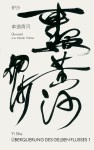
yi_sha_faz_feb_2017Aus dem Buch ÜBERQUERUNG DES GELBEN FLUSSES, erschienen bei Edition FabrikTransit.

img_0170

img_0284

Yi Sha_Cover_Web

fabrik_logo

MONDGEDICHT

2月 12, 2017

islam

MONDGEDICHT
(für eli, juliane und vati. for our friends. 新年好!)

der mond
ist ein gedicht
finster
voll
mehr oder weniger
manchmal hat er
einen haken
manchmal hat er
so viel getrunken
dass er unheimlich
leuchtet
oft ist er einfach
nicht erreichbar
etwas mit seinem handy
soll er den roten knopf drücken
oder den grünen?

MW Februar 2017

Martin Winter_Cover_WebMOON POEM

the moon
is a poem
brooding
obscure
fully
wasted
sometimes
sporting a hook
sometimes
drinking so much
she is fearfully
glowing
often
she’s not available
something with her mobile
should she press the red button
or maybe the green?

MW February 2017

cam01212

14691367_1816089702007744_923905569074801672_ofabrik_logo

cwlxmyxxeai7oar

ji_ji

yi_sha_faz_feb_2017 faz-yi_sha_feb_2017

balkon jiaozi hunde

Yi Sha: AUS ALTEN LIEBESBRIEFEN

Yi Sha_Cover_Web


Ai Weiwei News

6月 26, 2011
Liebe Freunde,
Ai Weiwei_Martin Winter
(Basler Zeitung Di., 27. Juli 2011)
Ai Weiweis Gedicht "Wir sprechen uns später" ist in der aktuellen Ausgabe der Zeit (7.-14. Juli). Kam am Donnerstag
heraus, nach China kommt die aktuelle Ausgabe immer erst am Montag, wenn sie kommt. Dann kostet sie 120 Volkstaler,
dreimal so viel wie in Deutschland. Die Übersetzung ist von Angelika Burgsteiner und mir. In den Tagen nach Ai Weiweis
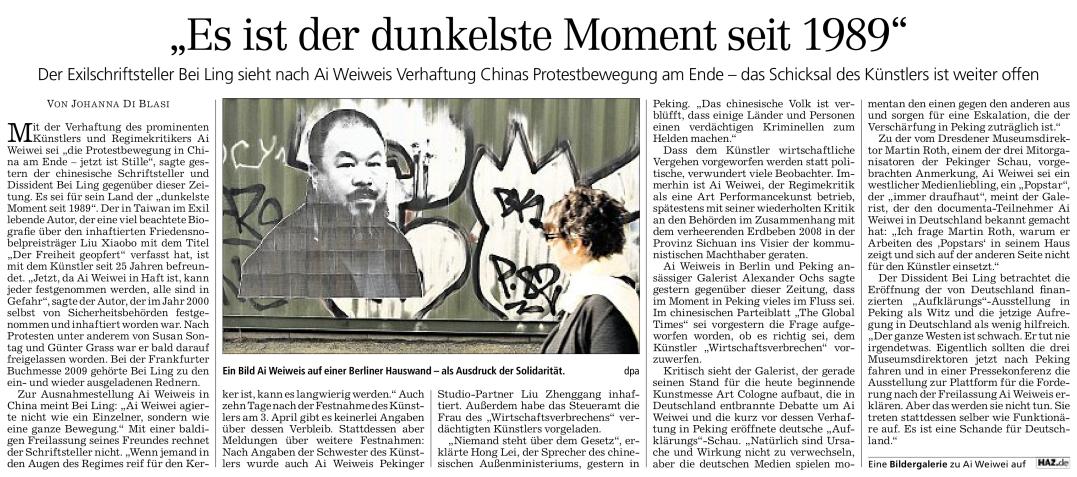
Freilassung war dazu ein Artikel von Bei Ling, den ich übersetzt habe, in der FAZ, in der Presse und auf derstandard.at.
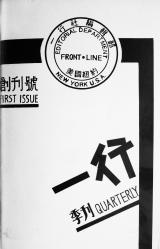
Das Gedicht erschien 1987 in der von Yan Li herausgegebenen chinesischsprachigen Zeitschrift Yi Hang (oder Yi Xing, d.h.
Eine Zeile/ Eine Gruppe) in New York. Ai Weiwei erinnert sich an das Gedicht, weil es das einzige ist, das er je geschrieben
hat, sagt er.
Zeit_2011_7.Juli_AiWeiwei
Wir haben Ai Weiwei am Freitag in der Früh besucht. Er wirkte noch ziemlich mitgenommen. Ich bekam den Eindruck, er wurde
eher zu von der Staatssicherheit vermuteten politischen Hintergründen von alten Fotos aus New York befragt als zu steuerlichen
Vorwürfen gegen ihn. Aber wir haben nicht viel gefragt. Für die Aktionen zu seiner Unterstützung war er sehr dankbar, obwohl
er bei manchen Sachen auch etwas skeptisch ist. Die aktuelle Ausstellung in Winterthur kommt bald nach Graz, und die Sache in
Bregenz fängt auch in diesem Monat an. Aber er kann ja leider nirgends selbst hinfahren. Manche Projekte, die er vorher begonnen
hat, scheinen ihm jetzt fast fremd geworden zu sein. Er möchte gerne gastfreundlich sein und frei reden wir früher. Aber wie er
selbst sagt, jetzt geht es ihm eben wie vielen anderen, und eher wie vielen gewöhnlichen Leuten, die auch nicht zuviel
den Mund aufmachen dürfen. Als Wegzehrung für den Rückweg haben wir ein paar Sonnenblumenkerne mitbekommen.
Herzliche Grüße, mw
http://www.newyorker.com/online/blogs/newsdesk/2011/07/liao-yiwu-leaves-china.html

Silence of the dissidents
The Ancient Roots of Chinese Liberalism 
台灣自由時報副刊全版刊〈草泥馬時代的艾未未〉文,照竟也全刊出了 
Yan Li's Chinese magazine in New York, 1987

The source for Ai Weiwei’s poem

严力:说说艾未未(之二) (2011.5)

严  力:说说艾未未(之三)

严力:说说艾未未(之四)

Hu Jia released after years in Chinese prison 

@faz_net Weit hinter der chinesischen Firewall http://t.co/LIbIuTv 貝嶺 Bei Ling (June 25). http://derstandard.at/1308679661187/Die-Freilassung-Ai-Weiweis-Ai-Weiweis-Zukunft Ai Weiwei mit Maulkorb: Wie lange wird er das aushalten? Der Aktionskünstler ist wieder auf freiem Fuß, aber unter scharfen Auflagen: Gibt es echte Freiheit für ihn nur um den Preis des Exils?

中文刊於6月24日台灣蘋果日報

英譯刊於6月25日台北時報(Taipei Times): What will be the price of Ai Weiwei’s freedom? By Bei Ling 貝嶺

Berliners for Ai Weiwei (He lost a lot of weight in prison, so he might as well have some!)

See also Berlin’s Tagesspiegel from June 23rd  柏林《每日鏡報》6月24日文化版

Ai Weiwei

4月 8, 2011

Interesting. Please click on the Global Times link (also at the bottom), read the article and then click on the “Related” links under the article. These other stories add a lot of perspective, through earlier and mostly positive Global Times coverage of Ai Weiwei’s various projects and activities. I remember seeing Lian Chan 連戰 on TV in Taiwan in the 1980s*. He was prime minister then, I think. Kept saying “Yi fa bali! 依法辦理”. To be handled according to law. Everything should be handled according to law. This was already after martial law 戒嚴 was lifted 解嚴 in 1987. But many opposition figures and activists were still in prison (they had a prison island, “Green Island” 綠島, for example) or barred from returning to Taiwan. Martial law had been lifted, but many laws from the One-Party-rule were still on the books, and actually still enforced (See the poem “After Martial Law Was Lifted – In Commemoration of Lifting Martial Law in Taiwan on July 15th, 1987” by Li Qin’an [李勤岸 – 解嚴以後 – 一九八七年七月十五日臺灣解嚴紀念] http://blogs.yahoo.co.jp/dujuan99nihon/30163376.html). Now which law is the Global Times article referring to? Let US bake our cake of social progress and eat it at the same time, and have it OUR way, and let nobody in the world talk too much about it, because this is the LAW. Right?
Very interesting how they keep on contradicting themselves. “Was said to have been detained”. Was he, or was he not? Maybe just kidnapped? “It was reported his departure procedures were incomplete.” Interesting. So which law will not concede before Ai Weiwei? Which departure procedures law? No, it’s THE LAW. Shoot first, deflect questions later.* Happens in every society.

Martin

======================================

Global Times (4/6/11):
http://en.huanqiu.com/opinion/editorial/2011-04/641187.html
Law will not concede before maverick
法律不会为特立独行者弯曲_评论_环球网: http://bit.ly/hwH7G4, most discussed on @dujuan99/china (http://bit.ly/evC5Ka) See also China Geeks (4/8/11).

魏京生: 从艾未未事件看中国法制的演变

Geremie Barme on Ai Qing and Ai Weiwei

Nude photos and other incriminating activities of Ai Weiwei

It’s really very simple, and even seems a bit tedious when you think about it. Yet I go on watching these shows. What else would you have me look at, dear readers?

Salman Rushdie

Who is afraid of Ai Weiwei?(Language Log)

貝嶺:裸體公民艾未未 (China Times, also in Ming Pao)

Naked Citizen Ai Weiwei (Ming Pao, Hong Kong, May 2011)

Photo by Katharina Hesse

There are many relations of this case to other arrests like the one on April 8 of Zhao Lianhai 趙連海, speaker for parents whose children had been poisoned by tainted milk.
Zhao had been released on parole after beeing imprisoned for “disturbing the peace”. But on April 6, he uplaoded a moving video, holding his child and trying to make a public statement at home.

FAZ

*This blog entry started out as a post on the MCLC email listserv. A lively discussion ensued. Andrew Field pointed out that Lu Xun 魯迅 and many other modern writers were banned in Taiwan under martial law. James Dew, Tim Wong, Kirk Denton, Christopher Lupke and others remembered how foreign students read these writers in a special room at Taiwan University, and how Chen Yingzhen 陳映真 connected to Lu Xun and the May Fourth tradition. Chen was imprisoned for “pro-communist activities”. Tai Jingnong 台静农 (1903~1990), a well-known writer and painter in Taiwan, was originally a student of Lu Xun.

* Jerome Cohen uses a similar expression in the South China Morning Post (4/27/11): “Second, it also seems clear that, whatever the evidence being assembled about tax evasion or other charges, this was not the motivation for Ai’s detention. This case started out on a ‘detain first and look for justification later’ basis.”

Chinese rock music related to Ai Weiwei: http://www.zuoxiaozuzhou.com/, via Jeroen Groenewegen

南都社论: 躺在时间的河流上怀念他们