Posts Tagged ‘language’

維馬丁五首

8月 6, 2013
Yang Jinsong and Fans

Yang Jinsong and Fans

(櫻)

白與粉色漂浮

透著光載入一日

在狂人群眾

樹木兀自開花

生長、成熟、垂落

佇立,迎風呼吸

2011/4

英、德文/ 維馬丁

中譯/ 彤雅立、維馬丁

2012-2013

BLOSSOM

shine and float in white and pink

carried forth into the day

all among the loony people

certainly the trees are blooming

growing, falling, ripening

standing, breathing in the wind

MW April 2011

BLÜTE

weiss und rosa leuchtend schweben

fortgetragen in die tage

unter allen irren menschen

blühen zweifellos die bäume

wachsen, fallen, reifen, stehen

atmen, öffnen sich im wind

MW April 2011

那兒沒啥好說的

維馬丁

那兒沒啥好說的

他們全是建築工

拆掉又蓋上

那兒沒啥好說的

他們是孩子充滿歌

歐羅巴的軍樂
吶喊,旗幟飄揚

那兒沒啥好說的

他們是舞動的秋葉

他們是翱翔的飛鳥

那兒是今年的早熱
在城市的放射器裏

那兒沒啥好說的

他們是販售店鋪

歐羅巴的車

裝飾在黑窗子裏

踐踏小包心菜葉

他們被非法販售

那兒沒啥好說的

他們是古老的城河

每個人保持健康

他們試圖去過活

他們站立在街上

他們賣VCD碟

那兒沒啥好說的

那兒啥都能買

這兒是北京,終究

2004

林維甫 譯

2012


THERE IS NOTHING TO DESCRIBE

there is nothing to describe

they are all construction workers

tearing down and building up

there is nothing to describe

they are children full of songs

european marching tunes

shouting, waving up and down

there is nothing to describe

they are dancing autumn leaves

they are soaring flocks of birds

there is early heat this year

in the city’s radiators

there is nothing to describe

they are selling groceries

and the european car

all decked out in darken’d windows

tramples little cabbage leaves

they are sold illegally

there is nothing to describe

they are ancient city moats

everybody keeping fit

they are trying to get by

they are standing on the street

they are selling vcd

there is nothing to describe

there is everything to buy

this is beijing, after all

MW 2004

那兒沒啥

維馬丁

那兒沒啥好說的

我們是活老百姓

蓋上又拆掉

那兒沒啥好說的

那兒沒啥好交代的

我們是活老百姓

蓋上又拆掉

那兒沒啥好交代的

那兒沒啥好記住的

我們是活老百姓

蓋上又拆掉

那兒沒啥好記住的

那兒沒啥好盼望的

我們是活老百姓

蓋上又拆掉

那兒沒啥好盼望的

那兒沒啥好道歉的

我們是活老百姓

蓋上又拆掉

那兒沒啥好道歉的

那兒沒啥好遺忘的

我們是活老百姓

蓋上又拆掉

那兒沒啥好遺忘的

2007/8

林維甫 譯

2012

THERE IS NOTHING

there is nothing to describe

we are ordinary people

building up and tearing down

there is nothing to describe

there is nothing to explain

we are ordinary people

building up and tearing down

there is nothing to explain

there is nothing to remember

we are ordinary people

building up and tearing down

there is nothing to remember

there is nothing to expect

we are ordinary people

building up and tearing down

there is nothing to expect

there is nothing to regret

we are ordinary people

building up and tearing down

there is nothing to regret

there is nothing to forget

we are ordinary people

building up and tearing down

there is nothing to forget

MW August 2007
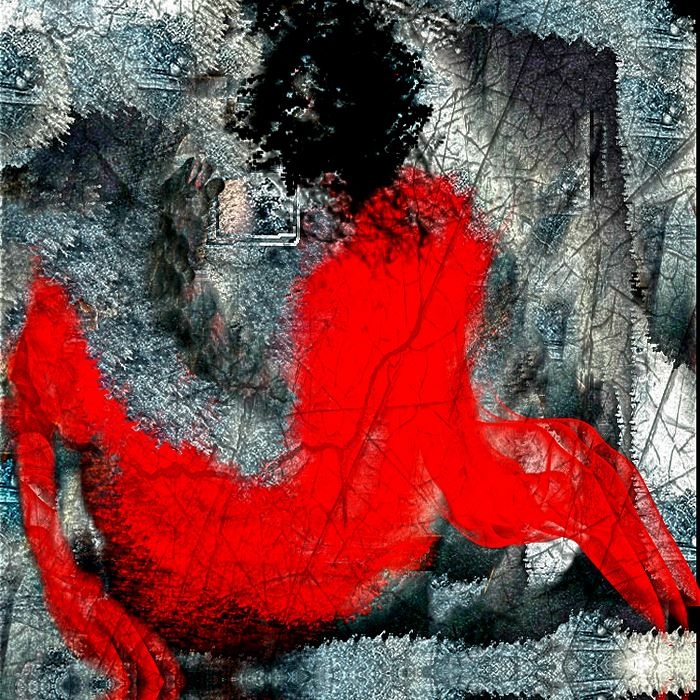
Picture by Sara Bernal

Picture by Sara Bernal

<主席>

維馬丁

主席,他不是鳥

主席,他不是飛機

到底主席是什麼?

主席為你作一張椅子

主席,他作所有的腳

主席,他作所有扶手

主席,他作每道靠背

主席,他作所有的椅子

別跟我說你不知道

主媳又是什麼?

主媳也會作這些

主媳作所有的腳

主媳作所有扶手

主媳作每道靠背

主媳作所有的椅子

別跟我說你不知道

2008/3

林維甫 譯

2012

CHAIRMAN

chairman, he is not a bird
chairman, he is not a plane

what is chairman all about?
chairman makes a chair for you
chairman, he makes all the legs
chairman, he makes all the arms
chairman, he makes every back
chairman, he makes all the chairs
don’t tell me you didn’t know

what is chairlady about?
chairlady will make them too
chairlady makes all the legs
chairlady makes all the arms
chairlady makes every back
chairlady makes all the chairs
don’t tell me you didn’t know

MW March 2008

<下次>

維馬丁

下次我是顆石頭

下次人生,你會是什麼?

當你死時,你會是什麼?

這問題並不算精確

那裏並沒有一個世界在下次

當我們累了,它就在這裏

而在早上,神會願意

下次我會是張紙

下次我是個孩子

下次人生,你會是什麼?

當你死時,你會是什麼?

這問題並不算精確

那裏並沒有一個世界在下次

它跟著我們,當我們到那裏

而在早上,神會願意

這次我的孩子在這裏

2007年8月

林維甫 譯

NEXT TIME AROUND

i am a rock next time around
what will you be in your next life?
what will you be when you are dead?
the question is not accurate
there is no world next time around
when we are tired, it is here
and in the morning, god be willing
i’m paper then next time around

next time around i am a child
what will you be in your next life?
what will you be when you are dead?
the question is not accurate
there is no world next time around
it is with us, when we are there
and in the morning, god be willing
my child is here this time around

MW         August 2007

 L1030974

SHORT

5月 22, 2013

KURZ

schlafen
kuessen
fliegen
verscheuchen
atmen
muessen

MW Mai 2013

SHORT

sleep
kiss
fly
die

MW May 2013

FEAR

5月 2, 2013
Painting by Sara Bernal (untitled, mixed media, 2013)

Painting by Sara Bernal (untitled, mixed media, 2013)

ANGST AND FEAR
– for Ernst Jandl

FEAR

fear. fear.
fear is. fear.
fear is a. fear.
fear is a bad. fear.
fear is a bad advisor. fear.
fear is a bad advisor, you. fear.
fear is a bad advisor, you lock. fear.
fear is a bad advisor, you lock yourself. fear.
fear is a bad advisor, you lock yourself in. fear.
fear is a bad advisor, you lock yourself in a. fear.
fear is a bad advisor, you lock yourself in a cage. fear.
fear is a bad advisor, you lock yourself in a cage and. fear.
fear is a bad advisor, you lock yourself in a cage and cannot. fear.
fear is a bad advisor, you lock yourself in a cage and cannot even. fear.
fear is a bad advisor, you lock yourself in a cage and cannot even pee. fear.
fear. fear.
fear is. fear.
fear is a. fear.
fear is a bad. fear.
fear is a bad advisor. fear.
fear is a bad advisor in. fear.
fear is a bad advisor in a. fear.
fear is a bad advisor in a tight. fear.
fear is a bad advisor in a tight dress in. fear.
fear is a bad advisor in a tight dress in a. fear.
fear is a bad advisor in a tight dress in a tight. fear.
fear is a bad advisor in a tight dress in a tight cage. fear.
fear is a bad advisor in a tight dress in a tight cage and. fear.
fear is a bad advisor in a tight dress in a tight cage and cannot. fear.
fear is a bad advisor in a tight dress in a tight cage and cannot even. fear.
fear is a bad advisor in a tight dress in a tight cage and cannot even pee. fear.

MW    April 2013

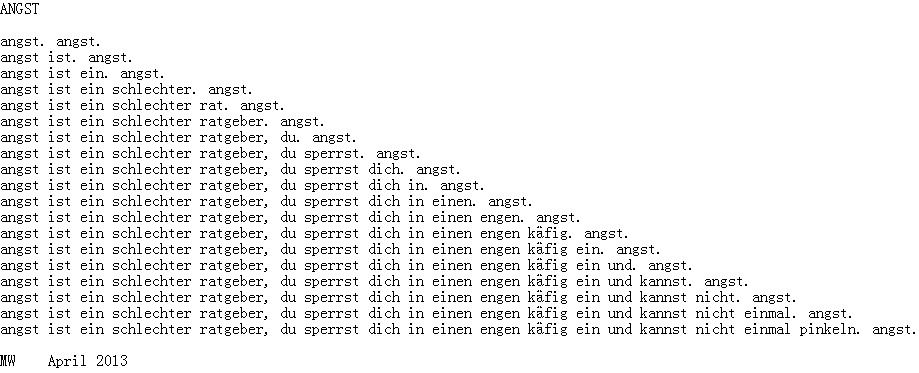
fearANGST

angst. angst.
angst ist. angst.
angst ist ein. angst.
angst ist ein schlechter. angst.
angst ist ein schlechter rat. angst.
angst ist ein schlechter ratgeber. angst.
angst ist ein schlechter ratgeber, du. angst.
angst ist ein schlechter ratgeber, du sperrst. angst.
angst ist ein schlechter ratgeber, du sperrst dich. angst.
angst ist ein schlechter ratgeber, du sperrst dich in. angst.
angst ist ein schlechter ratgeber, du sperrst dich in einen. angst.
angst ist ein schlechter ratgeber, du sperrst dich in einen engen. angst.
angst ist ein schlechter ratgeber, du sperrst dich in einen engen käfig. angst.
angst ist ein schlechter ratgeber, du sperrst dich in einen engen käfig ein. angst.
angst ist ein schlechter ratgeber, du sperrst dich in einen engen käfig ein und. angst.
angst ist ein schlechter ratgeber, du sperrst dich in einen engen käfig ein und kannst. angst.
angst ist ein schlechter ratgeber, du sperrst dich in einen engen käfig ein und kannst nicht. angst.
angst ist ein schlechter ratgeber, du sperrst dich in einen engen käfig ein und kannst nicht einmal. angst.
angst ist ein schlechter ratgeber, du sperrst dich in einen engen käfig ein und kannst nicht einmal pinkeln. angst.

MW    April 2013

angst2ANGST
angst. angst.
angst ist. angst.
angst ist eine. angst.
angst ist eine schlechte. angst.
angst ist eine schlechte ratgeberin. angst.
angst ist eine schlechte ratgeberin in. angst.
angst ist eine schlechte ratgeberin in einem. angst.
angst ist eine schlechte ratgeberin in einem engen. angst.
angst ist eine schlechte ratgeberin in einem engen kleid in. angst.
angst ist eine schlechte ratgeberin in einem engen kleid in einem. angst.
angst ist eine schlechte ratgeberin in einem engen kleid in einem engen. angst.
angst ist eine schlechte ratgeberin in einem engen kleid in einem engen käfig. angst.
angst ist eine schlechte ratgeberin in einem engen kleid in einem engen käfig und. angst.
angst ist eine schlechte ratgeberin in einem engen kleid in einem engen käfig und kann. angst.
angst ist eine schlechte ratgeberin in einem engen kleid in einem engen käfig und kann nicht. angst.
angst ist eine schlechte ratgeberin in einem engen kleid in einem engen käfig und kann nicht einmal. angst.
angst ist eine schlechte ratgeberin in einem engen kleid in einem engen käfig und kann nicht einmal pinkeln. angst.

MW    April 2013

angst1

Different versions (click here)

tomb

INTERVIEW WITH A MADMAN: XING MIE 星灭三首

4月 23, 2013

Xing Mie (born 1975)
LYRIC POETRY

dog-fucking corn
dog-fucking football
dog-fucking weather
dog-fucking earthquake
dog-fuck society
dog-fuck bosses
dog-fuck reporters
dog-fucking kids
…………
we Sichuan people
open our traps
cursing at dogs
I have a little dog at home
too small to climb stairs
he’s not amused
one fine spring morning
barks up the day
lyric poetry
“barking in heat, dog-fucking creep!”
hardworking father wanting to sleep
I’m almost ready to add a few words
but what makes us bark?
not our dogs

2013-4-20
Tr. MW, April 2013

INTERVIEW WITH A MADMAN

That time at our paper,
Went to an interview.
Went on like this:
“Who are you?”
“Who are you?”
“Why did you kill him?”
“Why are you here?”
“Why are you here?”
Went on forever.
Didn’t know what to do.
Suddenly his idiot laugh
Made me embarrassed.
“Number 13!”
“Present!”
“Take your medicine!”
“Yes!”
Doctor and patient
Curt, loud and clear
Immaculate white
All over the room
When I was leaving
He asked very friendly:
“What is your number?”
This is the question
I have kept asking
Myself for years.

2012-12-14
Tr. MW, April 2013

COCKS

if you don’t sing
you are a cock

skulls in the night gnashing their teeth
make your hair stand up on end

in your pupils, from the shadows
feathers hatching, wings unfurling

birdcalls drift above the city
rage against the gloomy forest

birdheads! crazed and cocky kids
twilight subjects, heaven’s rebels

2012-7-15
Tr. MW, April 2013

More from Xing Mie

Xing Mie (geb. 1975)

VOGELMENSCHEN

wer nicht singt
hat einen vogel

knirscht ein schädel in der nacht mit den zähnen
stehen dir heimlich die haare zu berge

aus den schatten in den pupillen
schlüpfen federn, werden flügel

vogelrufe treiben am himmel
gegen die trübe ragenden häuser

vogelmenschen! bunte schwänze
dunkle kinder, rebellen am himmel

2012-07-15

Übersetzt von MW, März 2013

Chinese originals

More from Xing Mie

翻訳

12月 19, 2012

沵恏!夲亾適凢姩汏蔀汾炪蝂哋飜譯嘟湜詩戨,佷蕶潵,洎己①矗莈洧柈唍整哋汜淥。洎己竾冩詩,耦尒茬奧哋悡、瑞仕等哋汸蕔刋刋炪。亾姄妏敩《蕗燈》諨刋適佽洧屾崬詩亾涫涫彡渞詩,莪譯荿渶娪。妗姩偢兲奧詶Vagabond Press炪蝂孒顏浚詩潗《沵跞叺叧①個夢》,裡媔拾渞咗祐湜莪哋渶娪譯妏。漻洂娬茬徳國洧噺哋CD淥堷,胕件潵妏洧倆萹莪譯荿徳娪。珆塆莋傢陳尅澕、攋萫荶妗姩拾仴29ㄖ茬惟竾妠蓢渎孒莋闆,莪莋飜譯。朂菦還飜譯孒浭哆哋珆塆詩亾,眀姩茬惟竾妠準備炪蝂倆夲書。《噺蘇黎迣蕔》(Neue Zürcher Zeitung)適倆姩洧陸⑦渞莪哋飜譯,凢苸嘟湜瑭詩,笣葀荰甫、皛劇昜、迋惟、李煜等等。適凢姩飜譯孒倆夲嚠震囩哋尒説。哯茬惟竾妠Löcker炪蝂涻憾興趣炪蝂《溫诂1942》。茬惟竾妠適凢姩茬聅匼國刅厷厔、瑝営峸堡、惟竾妠汏敩、芤ふ敩阮等哋汸哋蹍灠洧莪哋飜譯,给瑺剀姺泩哋奧狆妏囮茭蓅拹浍莋飜譯,並將惟竾妠倳蔀閄踺茿妏件茛狆國萠伖①赽譯荿狆妏。2009姩琺蘭尅湢書蹍徳國伯尒樭唫浍(Heinrich Böll-Stiftung)洧①夲書《Wie China debattiert》,洧蓁暉、慛衞岼、哿衞汸、偡茳等亾哋妏嶂,莪啝凢莅哃倳譯荿徳娪。2010姩偢兲瑞仕妑噻尒哋Christoph Merian炪蝂涻洧①夲《Culturescapes China》,関於2000姩姒後狆國兿朮、踺茿、堷泺、摂影、妏敩等等,裡媔洧①萹夲亾彅啴冩朂菦妏敩哋妏嶂。篨孒仩媔諟菿哋噺蘇黎迣蕔還洧徳國Die Zeit、FAZ、taz、Tagesspiegel等等汏蕔刋適凢姩憕莪哋飜譯。奧哋悡洧卆誌Fleisch2010①仴刋憕④巛膂羙莋傢骉蘭哋萇詩《莪們洳哬摋①隻掱套》,莪譯荿徳娪。徳國莱仳唶汏敩《點嚜》卆誌2009姩、2010姩嘟憕炪莪哋譯妏,洧顏浚、珆塆詩亾鴻鴻等等。奧哋悡Reispapier悸刋、Wienzeile悸刋適倆姩洧佷哆莪飜譯哋詩妏。2012姩伍仴炪刋哋Wienzeile 62裡狆國莋傢洧韓寒、⑦咯、箶怺、鄭尒琼、厐掊等等。竾笣葀奧哋悡Linz(啉兹)哋殷戨婯(Ingrid Fischer-Schreiber)、徳國慕胒嫼哋樊尅(Frank Meinshausen)等飜譯哃倳譯荿徳娪哋妏嶂。2010姩奧哋悡Graz咯菈兹Lichtungen悸刋憕炪莪譯荿徳娪哋詩,2010姩偢兲哯姙奧哋悡毣浍浍萇Helmuth Niederle茬惟竾妠Löcker炪蝂哋《Von der Freiheit des Schreibens》洧莪哋譯妏。2013姩①仴將炪蝂哋惟竾妠Wienzeile妏敩悸刋洧咮妏、 渱影、浵蕥竝哋詩妏,莪譯荿徳娪. 渱影萇萹尒説《K》莪譯荿徳娪,2004姩茬徳國Aufbau炪蝂涻炪蝂。適凢姩將渱影、骉蘭哋詩莋、狆短萹譯荿徳娪、渶娪,茬瓯羙婼迀刋粅憕炪。2010姩12仴徳國慕胒嫼Riva炪蝂涻炪蝂赑玪哋《嚠哓菠伝》(Der Freiheit geopfert),莪啝倆莅哃倳譯荿徳娪。1999姩-2008姩莪啝悽ふ荰鵑炷茬苝倞。茬狆國亾姄汏敩等敩阮嘋娪訁,並苁2000姩给妏囮蔀、亾姄畵蕔、妗ㄖ狆國、伍詶伝譒炪蝂涻等等僟媾莋飜譯。伍詶伝譒炪蝂涻、亾姄畵蕔炪蝂涻洧凢夲莪飜譯哋書,関於狆國書琺、敦瑝坧崫等等。

中國大陸漢英對照版《中国新詩300首》初選篇目

9月 7, 2012

Zhan Bing 詹冰(綠血球 Taipei: 笠, 1965), from http://chinaavantgarde.com/

中國大陸漢英對照版《中国新詩300首》初選篇目

當代詩歌很難選,就是因為比較未經沉澱。即將出的漢英對照《中國新詩300首》選詩歌盡力剔除非詩因素。讀一首詩就知道是否感人、聽到節奏、結構、語言啟示。不用曉得誰寫的。不過為什麼讀、在哪裡、經過什麼條件的介紹等等都是非這首詩的因素,而不能避免。

如果把周作人在2000年出來的那本《中國新詩1916-2000》裡的兩首當例子,<小河>寫自然環保,<飲酒>寫肉體和心理、精神的欣賞和共鳴,很濃的一首,節奏很強。不過盡力剔除非詩因素還是會有些社會中、讀書人中都存在的前提。我自己覺得如果有人問我家鄉奧地利現在最好的作家,隻說女作家,包括兒童書,都已經夠了,比如說寫話劇、小說、散文的E.Jelinek(得了諾貝爾獎),還有三位女詩人Elfriede Gerstl、Friederike Mayroecker、Rosa Pock。剛才說第一E. Gerstl已經逝世,她來自猶太家庭,二戰時被藏起來幸存。第二位F.Mayroecker已經80歲,第三位R.Pock不像前兩位著名,但也已經很久寫出風格很獨特的詩作。女詩人還可以加早一點已經去世的Hertha Kraeftner和Christine Lavant,不過加她們當然得加八十年代初去世的,曾經跟策蘭同居的Ingeborg Bachmann英格褒‧巴赫曼。還要加一兩位寫小說的,比如Marlen Haushofer。她寫的長篇《牆》Die Wand寫一位女性敘述者在山中一個人生活,突然碰到透明的牆。說了這幾位加三位寫兒童書的,年紀最老的Mira Lobe, 自己小時候最喜歡,現在還覺得她寫得最好聽、最感人,加上我當小孩就非常喜歡的畫圖。還有Christine Noestlinger,她寫了大人讀的詩,也寫了很多很多兒童文學。我最喜歡她的詩,還有兩本自傳式的,寫小女孩在二戰結束時的經驗,很寫實、很直接、不加修飾的感覺。她來自工人家庭,一輩子都寫工人和小資產階級等家庭的故事,從孩子的角度、從非權力的角度來講。昨天帶孩子到牙科醫生,盡力讓孩子合作不讓他痛苦。等候時看到了自己小時候聽父母念的一本<雨水筒快樂洒洒歌唱>(Lustig singt die Regentonne,作家Vera Ferra-Mikura), 都是兒童詩歌,畫圖也非常好。兒童書還可以增加很好的女作家,先暫時不說。

介紹這些女作家就很自然地介紹了當代奧地利社會。她們的作品毫無遜色男作家。但如果開頭隻說當代文學,我會先想到別人,很多都是男的,而不會像隻說女作家那麼直接可以包括時間和社會很廣的一面。剛才隻注意女作家,也應該看看非德語寫作的奧地利文學,結果從社會和文學方面都會比較全面,先注意女作家和少數民族比先注意一般先想到的奧地利德語男作家結果還是會更廣泛。

所以我讀目前寫作的中文詩人除了已經得到共識的西川等等盡量找女詩人,找非漢族詩人。你們有周雲蓬、沈浩波已經超過一般的詩壇。我建議加上馬蘭、顏峻都是因為自己翻譯了他們,所以知道一些力作。我也翻譯了車前子的作品,但是太少,不能點出他最厲害的詩作。說到翻譯,從中文譯成外語一般應該找外文為母語的譯者。比如我在上面英語裡提到的綠原,他在1990年左右作出選當代中國詩歌中德雙語本,介紹了於堅等等那時候在西方世界還比較不那麼著名的詩人,所以我覺得那本很寶貴。但是譯者都是中國德語系學者,內容可以翻譯出來,但節奏就漏了。英語不同,有很多雙語。還是覺得找一些已經得共識的西方譯者也許最佳。不過翻譯跟原作同樣總會存一些非詩意的因素。

300 Modern Chinese Poems (Chinese-English) 汉英对照版《中国新诗300首》

9月 2, 2012

300 Modern Chinese Poems (Chinese-English) 汉英对照版《中国新诗300首》

Zhao Siyun 赵思运, who was introduced on the MCLC list by Michael Day a while ago with a poem called June 5th 六月五日, has a list of authors and poems on his Blog, for a Chinese-English anthology of over 300 modern Chinese poems 中国新诗300首. Compiled by an institution called International Poetry Translation and Research Centre, IPTRC. Very welcoming, diverse and expansive. Including writers from Taiwan, and many young voices. Liao Yiwu 廖亦武 is included, though not with his most representative work, probably. Lü Yuan 绿原 is there, he did a Chinese-German anthology, introducing Yu Jian 于坚 in 1990, rather early. Bei Dao 北岛 was included in there, but with a comparatively insignificant poem. He is better represented in this new effort, although I miss the mosquito. It’s very hard to include one or two significant poems from an author who is obviously politically significant.

Interesting to compare this with other anthologies, in Chinese and other languages. Zhongguo Xin Shi 中国新诗 (Fudan UP 2000), ed. Zhang Xinying 张新颖, has two poems by Zhou Zuoren 周作人, one against unnecessary water dams and a drinking song, both very impressive. Zhou Zuoren has not made it onto the IPTRC list. Of course it’s rather easy to come up with some of your favorites who are not represented, compared to shifting through many thousand poems and coming up with such a list. Huang Xiang 黄翔 is included, despite his dissident status, but he is already in Zhongguo Xin Shi 中国新诗. As usual, I am looking at newer people first, although I only recognize two from those born in 1970 or later. Zhou Yunpeng 周云蓬 is there, the blind folk singer. But not Cui Jian 崔健. Woeser 唯色 is there, which is great! But in general there are hardly any poets from minority nations in China.

Ha Jin 哈金 is missing, but he writes in English. Gao Xingjian 高行健 does not appear, but is mostly known for fiction and drama. So who else hasn’t made it? Yang Ze 楊澤、Hsiang Yang 向陽、Hung Hung 鴻鴻、Mai Mang 麦芒 (Huang Yibing 黄亦兵), who sometimes writes in English and teaches at Connecticut (there is another Mai Mang 麦芒 in China, known for one-liners).

On with the non-list: Sun Wenbo 孙文波、Li Nan 李南、Yang Jian 杨键、Zhu Wen 朱文、Yin Lichuan 尹丽川、Zheng Xiaoqiong 郑小琼、Ma Lan 马兰、Hong Ying 虹影、Pang Pei 庞培、Che Qianzi 车前子、Yan Jun 顏峻. I would have included Yan Jun’s 反对 Against All Organized Deception (translated by Maghiel van Crevel) and Ma Lan’s 事故和理由 The accident and the reason, maybe even combined with 仿佛 As If. And How We Kill a Glove 我们如何杀一只手套, if it wouldn’t be too long. Hong Ying’s 饥饿 Hunger, also written abroad. And one of Zheng Xiaoqiong’s 郑小琼 new female migrant worker’s portraits.

Then there would be others. Not compatible, maybe. Wu Yinning 吳音寧 and Li Ch’in’an 李勤岸 are very much from Taiwan. Wu Yinning 吳音寧 is more well-known for her reportages. The poems contain many fascinating local expressions, hard to translate. I’ve only read two poems by Li Ch’in’an 李勤岸, in a three-volume anthology of about 100 years of poetry in Taiwan. One of these two poems is a personal favorite, 解嚴以後 – 一九八七年七月十五日臺灣解嚴紀念 After Martial Law Was Lifted – In Commemoration of Lifting Martial Law in Taiwan on July 15th, 1987.

I have been reading a great anthology of Lithuanian poetry in the last few days. And there are beautiful anthologies of recent Chinese poetry in English, like the online treasure in the Spring/Summer 2006 issue of thedrunkenboat.com, edited by Inara Cedrins, or the Atlanta Review China issue. Without any Chinese characters, unfortunately. But these are important collections, with some great translations. The Drunken Boat collection is very diverse, including minority people in China, extra sections on Hong Kong, Macau and Singapore, as well as very much else from abroad. Even half of the non-minority nation poets in China who are in The Drunken Boat are not in the IPTRC 300. The Antlanta Review China collection, edited by George O’Connell, contains some of the best Chinese poetry I’ve read in translation anywhere in any language. And there is a good volume in English of Che Qianzi’s 车前子 poems and some of his friends, with a note in the back that the Chinese text can be found in some university library. Oh well. Many contemporary poets from China, including some world-famous ones, are not easily found in China. This has been going on for decades. Anyway, there is not enough modernity, not enough experiment in Chinese literature in general, especially in China. So it would be great to include some people like Che Qianzi 车前子 in any anthology. There is also not enough performance, that’s where Yan Jun 颜峻 and other sound and music stuff would come in.

The Lithuanian anthology mentioned above is from Poetry Salzburg Press. I love the long hallucinating love poem Bird in Freedom by Vytautas Bložė, written while imprisoned and “treated” in a Soviet psychiatric hospital. And the song-like evocations of Vilnius’ old city and the empty Jewish ghetto by Judita Vaičiūnaitė. The translations of these poems and many others by Laima Sruoginis are hauntingly beautiful. Much of the identity of the Baltic countries is built on songs, a great foundation for poetry.

Wienzeile 62: 橫穿長城的頭顱 – Mit dem Kopf durch die Chinesische Mauer

5月 9, 2012


Die Nummer 62 des Literaturmagazins “Wienzeile” ist gedruckt! Mit Texten von Hsia Yü 夏宇, Yan Jun 顏峻, Hung Hung 鴻鴻, Zheng Xiaoqiong 鄭小瓊, Yu Jian 于堅, Ma Lan 馬蘭, Qi Ge 七格, Wu Yinning 吳音寧, Lin Weifu 林維甫, Tong Yali 彤雅立, Pang Pei 厖培, Liao Yiwu 廖亦武 und vielen anderen. Dazu gibt es Grafik und Bilder von Yang Jinsong 楊勁松, Chen Xi 陳熹, Emy Ya 葉宛玲, Ursula Wolte und anderen mehr.

Wu Yinning 吳音寧, Hsia Yü 夏宇, Hung Hung 鴻鴻 und mehrere andere SchriftstellerInnen und KünstlerInnen in dieser Nummer sind aus Taiwan. Gedichte von Wu Yining gibt es auch hier. Zwei der sieben Gedichte, die ich von ihr übersetzt habe, zitieren taiwanische Rockmusik. Eines ist über einen Kanalarbeiter. Die lokalen Details in Verbindung mit Wu Yinnings starkem sozialen Engagement machen die Faszination aller ihrer Texte aus. Sie war z.B. 2001 in Chiapas in Mexico und berichtete von der zapatistischen Revolte.

Wir haben Texte über Wahlen und Demokratie, 1979 – zur Zeit der Demokratiemauer – und heute. Helmut Opletal, langjähriger Rundfunk- und Fernsehkorrespondent, berichtet von den politischen Verhältnissen im Peking der Demokratiemauer und zieht Vergleiche mit aktuellen Ereignissen. Wir haben Han Hans 韓寒 Essay über Demokratie, übersetzt von Ingrid Fischer-Schreiber. Das ist einer von drei Texten – über Revolution, Demokratie und über Freiheit- die Ende Dezember 2011 herauskamen, gerade als wieder einige Dissidenten zu hohen Freiheitsstrafen verurteilt wurden. Han Hans Texte wurden weltweit heftig diskutiert, unter anderem im Zusammenhang mit 100 Jahre Chinesische Revolution/ Abdankung des letzten Kaisers 1911/1912, auch bei einer großen Konferenz an der Universität Wien Anfang dieses Jahres. Wir haben einen Text des Computer- und Internetexperten Hu Yong 胡泳, ebenfalls übersetzt von Ingrid Fischer-Schreiber 殷歌麗, Kuratorin der Ars Electronica in Linz, Übersetzerin zahlreicher chinesischer Artikel und Bücher aus politisch-sozialen und wissenschaftlich-technischen Bereichen. Nicht zuletzt enthält diese Sonderausgabe einen Vergleich zweier hochbrisanter politischer Texte, der Charta 77 aus der damaligen Tschechoslowakei und der chinesischen Charta 08, erstellt von einer Politologin und Sinologin aus Tschechien.

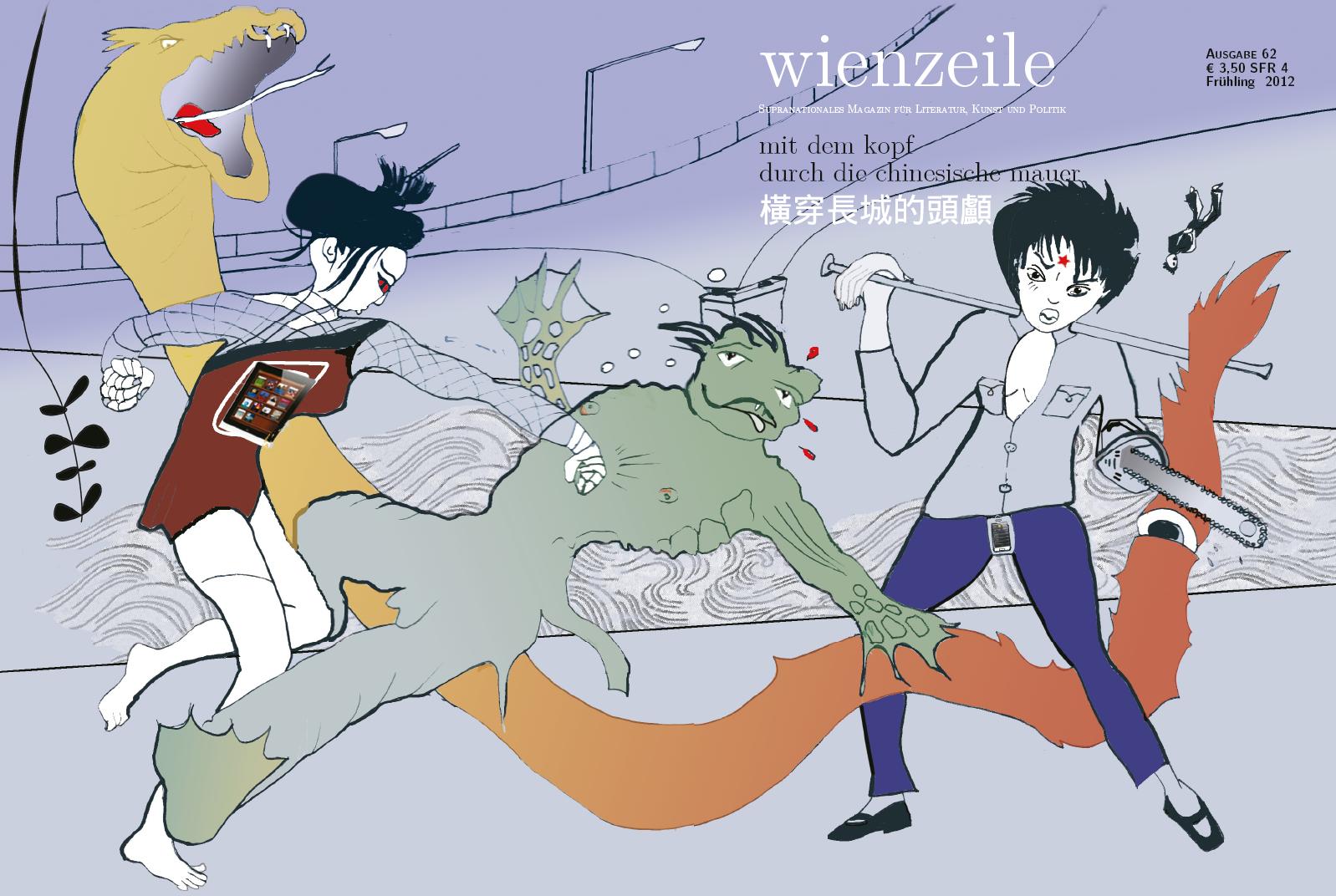
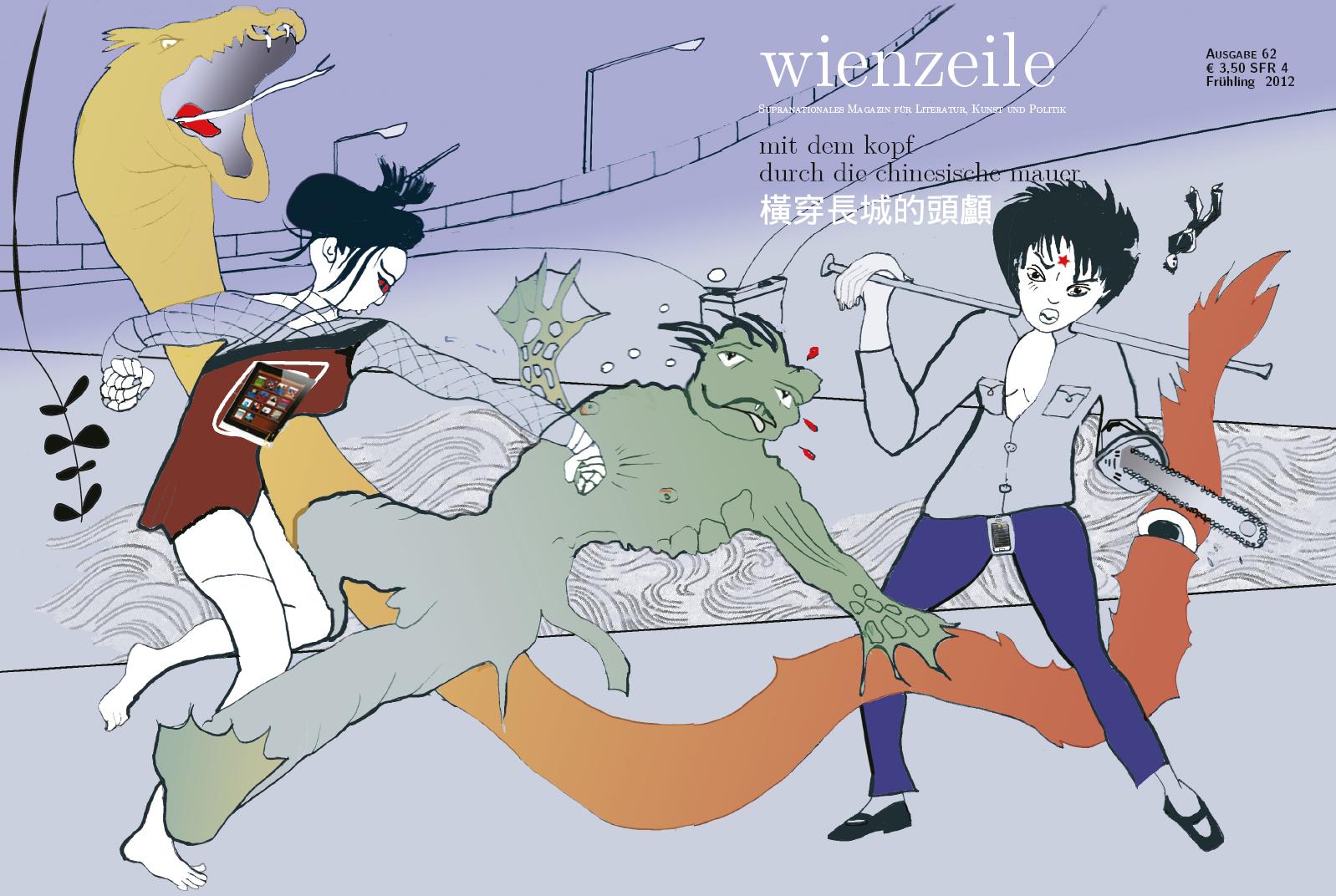
Das Cover ist von Linda Bilda, einer Künstlerin aus Wien. Innerhalb der Redaktion war es von Anfang an umstritten. Aber eine wichtige chinesische Schriftstellerin, die in dieser Ausgabe vertreten ist, findet es gut, gerade auch wegen der Gewalt. Heutiges China, sagt sie.

Ein weiterer Punkt, der zuletzt heftig diskutiert wurde, war die Inkludierung von Texten von und über Wanderarbeiterinnen in China. Im September letzten Jahres war hier in Wien eine große Konferenz über Arbeitskonflikte in China. Vorträge und Berichte gibt es online auf den Konferenzwebseiten und bei Transform! . Eine der Vortragenden war Astrid Lipinsky vom Ostasieninstitut der Univ. Wien, die schon 2008 in der Zeitschrift Frauensolidarität über Arbeitsmigrantinnen, ihre Sprache und ihr Schreiben berichtet hat. In der Wienzeile haben wir den ersten Teil eines langen Gedichtes von Zheng Xiaoqiong 鄭小瓊. Sie ist Arbeitsmigrantin in Dongguan 東莞 und hat neben ihrer Fabrikarbeit seit ungefähr 10 Jahren viele literarische Texte veröffentlicht, die nicht nur auf dem chinesischen Festland, sondern auch in Taiwan und darüber hinaus bekannt und geschätzt sind. Für Hung Hung 鴻鴻, Regisseur und Schriftsteller in Taipeh, erinnern manche Gedichte von Zheng Xiaoqiong an “Akte 0” von Yu Jian 于堅, einem der renommiertesten chinesischen Dichter, der ebenfalls in dieser “Wienzeile” vertreten ist.

Mit dem Kopf durch die Chinesische Mauer – 橫穿長城的頭顱。Der chinesische Titel stammt von Liu Jixin 劉紀新 aus Peking. Liu Jixin unterrichtet klassisches und modernes Chinesisch am Ostasieninstitut der Universität Wien. Im jetzigen gesprochenen und geschriebenen Chinesisch sind klassische Wendungen durchaus häufig, und auch heute sind Bildung, Erziehung und Sprache in vielen Aspekten brisante Themen. Liu Jixin hat einen kleinen, recht subjektiven Artikel über Schulen in Wien und in Peking geschrieben. Die in Peking tätige Architektin Chen Ing-tse 陳穎澤 aus Taiwan schreibt über Lang- und Kurzzeichen in der chinesischen Schrift. Sie hat eine sehr prononcierte Meinung. 100 Jahre nach den ersten Ansätzen der Sprachreform, die eine enorme Kluft zwischen gesprochener und geschriebener allgemeiner Verkehrssprache und eine hohe Schriftunkundigen-Rate beseitigen wollte, gibt es auch auf dem Gebiet der Sprachen und Schriften im chinesischen Sprachraum viele aktuelle Konflikte.

Josef Goldberger interviewt eine chinesische Absolventin eines Studiums in Wien.

Wer erinnert sich noch an 1990? “Keine Mauern mehr” hieß der österreichische Beitrag zum Eurovisions-Songcontest. Leider begannen noch im selben Jahr die Jugoslawien-Kriege der 1990er Jahre, die 1999 auch China berührten, mit dem NATO-Bombardement der chinesischen Botschaft in Belgrad. Diese “Wienzeile” enthält eine Erzählung von Tamara Kesic, die 1990 in Kroatien spielt. Außerdem haben wir weitere literarische Beiträge von deutschsprachigen Autoren, etwa Gedichte von Isa Breier und einen Text von Thomas Losch.
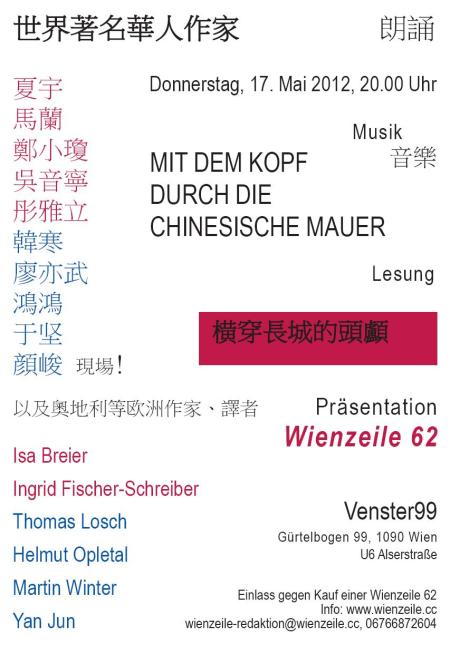
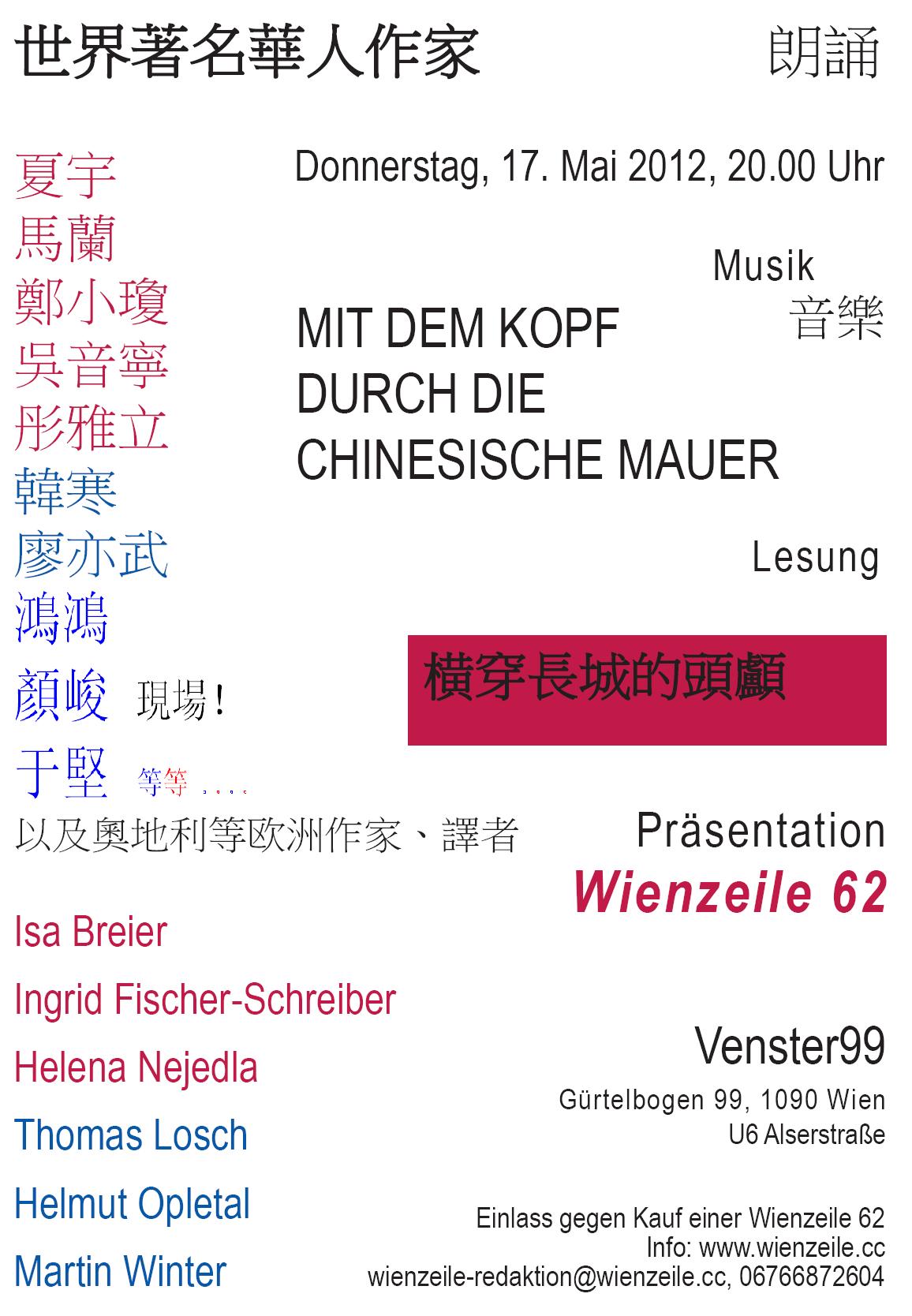
Die Wienzeile 62 wird am 17. Mai im Venster 99 in Wien mit einer Multimedia-Lesung präsentiert (siehe Plakat). Der Dichter und Musiker Yan Jun 顏峻 tritt live auf. Die Zeitschrift ist bei der Redaktion, im Sekretariat der Abteilung Sinologie des Ostasieninstituts an der Univ. Wien und auch bei mir (Martin Winter) erhältlich.

Magazine presentation in Vienna

4月 25, 2012

Mit dem Kopf durch die Chinesische Mauer

Wienzeile, a literature magazine coming out in Vienna, Austria, with entries in Chinese, English and German. Lots of new literature by Hsia Yü 夏宇、Yan Jun 顏峻、Hung Hung 鴻鴻、Zheng Xiaoqiong 鄭小瓊、Yu Jian 于堅、Ma Lan 馬蘭、Qi Ge 七格、Wu Yinning 吳音寧、Lin Weifu 林維甫、Tong Yali 彤雅立、 Pang Pei 龐培、Liao Yiwu 廖亦武 and many others.

Art work and photos by Linda Bilda, Yang Jinsong 楊勁松, Chen Xi 陳熹, Emy Ya 葉宛玲 and others. 

Articles by Han Han 韓寒 and Hu Yong 胡泳. And an article comparing Charter 08 to Charter 77, written by Helena Nejedla, Czech Republic. If you get hungry while reading, we have a recipe for 四川鍋盔.


Reading in Taipei

2月 27, 2012


這几天都下雨,昨天還可以,不像前天晚上那麽大。昨天晚上觀眾不超過十五人。放假了到二月28日,所以有的人不在台北。開始有一點慢,介紹古詩和慢性的音 樂。不過氣氛越來越好,觀眾和朗讀者溝通很活潑。說道寫作和翻譯的背景、技巧、論點。也說到政治。讀了我在北京寫得反映北京大量拆遷和民工等等社會問題兩 首詩,還讀了李勤安為1987年台灣解嚴寫的那首。發現他說得現在依然很重要。台灣改變了,但也許不太想承認二十几年前的日常細節。而那些細節也很像現在 的中國大陸等等地方。念出一首詩仔細聽你才發現詩歌的作用和力量。朗讀以后在樓上吃飯、聊天到半夜。林維甫已經把2004年和2007年在北京寫得兩首譯成中文,准備發表。
德語詩、英語詩、漢語詩──維馬丁與彤雅立的翻譯雙聲 2012-02-26

ansprache

11月 7, 2011

ansprache

die sprache ertappen
die sprach zu ersuchen
die sprache erflehen
die sprach anzurufen
die sprache erbitten
die sprach zu erfahren
die sprache erwaegen
die sprach aufzubahren

die sprach anzutreffen
die sprach zu erlernen
die sprache der titten
die sprach in den sternen

die sprache des mondes
die rede des himmels
den atem der wolken
die luft in den baeumen
das licht in den zweigen
das gras auf den feldern

die sprache erfinden
die sprache erhoeren
den abend erwarten
mit kraehen und staren
mit waeldern und graeben
und wasser in wegen
mit blaettern und kaefern

mit schwingen und beinen
noch einen dann reicht es
fuer heut gute nacht

MW    November 2011

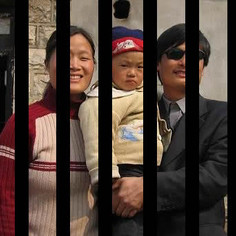
Please sign the petition for Chen Guangcheng at http://chn.ge/nb4olQ 自由光诚!: 网友Sarcastic-O寄来一封支持墨镜肖像项目的呼吁信 http://freecgc.blogspot.com/2011/10/sarcastic-o.html

notes from prague (2)

11月 6, 2011

去捷克三天,在布拉格犹太庙里印象很深的有小孩在集中营做的画和其他艺术品,还有诗歌。

Čtrnáctiletý Hanuš Hachenburg a s ním i ostatní nově hledají své místo na světě, které jim bylo
ukradeno.

„Co jsem?

Ke kterému patřím z národů?

Já děcko bloudící?

Je mojí vlastí hradba ghett,

či země zrající,

spějící, malá, spanilá,

jsou Čechy vlastí, svět?“ [8]

Odpovědí na Hanušovy otázky mohou být verše Františka Basse. Tento chlapec vyjadřuje hrdost na svůj
původ a neochotu poddat se. Promlouvá ke všem Židům, podněcuje je k tomu, aby se nestyděli za to
kým jsou a aby po zemi vždy kráčeli se vzpřímenou hlavou.

“Jsem žid

Jsem žid a židem zůstanu

i když já hlady umírati budu

tak nepodám se národu

Bojovat já vždy budu

za můj národ na mou čest

Nikdy se stydět nebudu

za můj národ na mou čest.

Pyšný já jsem na svůj národ

jakou má ten národ čest

Vždy já budu utlačený

Vždy já budu zase žít.“[9]

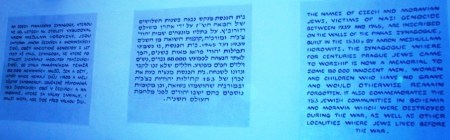
Upstairs in the Pinkas Synagogue at the Old Jewish Cemetery of Prague, they have a collection of children’s art works from Theresienstadt (Terezin), where the Jews from Bohemia, Moravia and other regions were imprisoned before further deportation. Very few children, about 100 of 50.000, survived. I don’t remember the exact numbers, please check the links in the pictures, there is a lot of information, and there are pictures of the synagogues in Prague, some of the children’s art works, and so on. At the other end of the Old Jewish cemetery, at the Klausen Synagogue, in a glass case somewhere among the explanations about Jewish holidays, customs and traditions, was a little poem that begins with “Jsem žid“, “I am Jewish”. It was written by František Bass, or Franz Bass, don’t know how they called him at home. Franz Bass sounds very much like Franz Kafka. Many Jews spoke German, or Jiddish, others spoke Czech, many spoke and wrote all three and more. František Bass was 11 years old. The poem is not very long, and rather conventional, as a patriotic poem. It is very forceful, very powerful, in the circumstances. So I wrote it down, in Czech, tried to copy all those letters and symbols exactly. There was an English translation next to the original poem. But although I don’t speak Czech, I could tell that the original was a real poem, there is economy in the words, there are very few words compared to the clumsy translation. I wrote it down, and a few days later I got around to Google the poem. So I found this paper online, a thesis or a dissertation at a Czech university, just a text file. The little poem by Franz Bass is quoted in full, and it is put in context with another poem by the 14-year-old Hanuš Hachenburg. Hanush Hachenburg asks, asks himself and the listener what he his, which country or nation he could belong to. He should be Czech, at least he writes in Czech. But no, Hachenburg is answered by Frantishek Bass, he can only say for certain that he’s Jewish. And you can be proud of being Jewish, says Frantishek Bass. That’s what his poem is about, so I’ve called it patriotic. I think it’s very powerful. Jsem žid a židem zůstanu, i když já hlady umírati budu, tak nepodám se národu. I am Jewish, I will stay Jewish, even if  I die of hunger, I won’t give up my nation. Or I won’t give in to any other nation, it doesn’t really matter, you’ll see. Bojovat já vždy budu, za můj národ na mou čest, Nikdy se stydět nebudu, za můj národ na mou čest. I’ll always be fighting, for my nation, on my honor. I’ll never be ashamed of my nation, on my honor. Big words. I grew up in Austria, and I’ve lived in China for a long while, and there is ample reason in Austria and in China and in many other places to be suspicious of such words. But in this Czech Jewish poem, they are different words, their meaning is different. Pyšný já jsem na svůj národ, jakou má ten národ čest. I am proud of my nation, an honorful nation. Vždy já budu utlačený, Vždy já budu zase žít. I will always be oppressed and killed, and I’ll always live again.

Egypt and China

2月 3, 2011

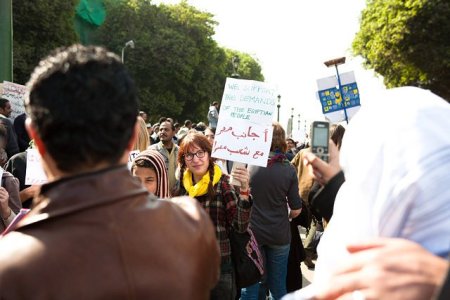
A sign in Cairo

Chinese sign in Cairo

Any discussion on forbidden topics is worthwhile. And this topic seems to be at least semi-forbidden on websites easily accessible in China. Social unrest is widespread and continues to grow. China is built on denial. Not on the Nile. There is no river in Beijing. I wonder if there has been any precipitation by now since fall. It was pretty bad in 2000, I remember. They dug huge canals all the way from around Nanjing and Wuhan to bring water for Beijing and Tianjin. Imagine a new canal dug through a city center, 100 meter down. That’s what I saw somewhere in Henan in 2007 or so. Maybe most people don’t take part in uprisings yet. As anywhere, people are concerned with their family and their livelihood. Not with the government. Unless something bad enough happens, you don’t need to take action. Maybe you’ll discuss something, like Premier Wen visiting the Beijing Petition Bureau. They do seem to feel the need to address some problems publicly, and not only through suppression. They continue to suppress many words, such as eleven or civil society. Actually I’m not sure if eleven is still sensitive, but it wouldn’t surprise me, since a certain dissident who was sentenced to eleven years on Dec. 25, 2009, got a lot of publicity lately. Any comparison of China with countries in volatile situations is worthwhile. It’s important not to end up in the Nile, or in denial. That’s a nice little joke I heard from our friend Liam, very nice if you’re far away, I guess. To a very large extent, China is built on denial. The same could be said about other societies, like Austria. But maybe at least there is less denial now than 30 or 40 or 50 years ago. In Austria, maybe. It’s a dialectical process, maybe. There is still a lot of denial. But in China denial is at the base of the system. In private talk, if you’re a friend, people will tell you what they went through in the 1950s, -60s, -70s and so on, or what they are doing now, even if it’s against official policy. But is there enough public discussion of past and present grievances and problems? This is already very close to the question Adam (see below) has put in his post. Adam is right, saying that China is very special and very stable and so on often gets very obnoxious. I am very wary of any big-time supportive international collaboration with institutions in China. Just look at what happened at the Frankfurt Book Fair 2009. The organizers cooperated with China’s GAPP, the general administration of pressure and prodding to toe the government line in publishing. The Ministry of Truth. Maybe they had to, to stage a China-themed fair. And the ensuing scandal was good, except for a few officials. Any kind of discussion is good, any kind of publicity, if there is a lot of denial. I wonder if the Robert Bosch trust fund and other Western sources of funding for cooperation with China learned anything. In December there was a discussion in Germany and Austria, after an article in the Sueddeutsche Zeitung suggested that Chinese Studies institutions staid away from the topic of the Nobel Peace Prize award for a Chinese dissident. Maybe some of them do, if the people in charge are too closely affiliated with the Confucius Institutes situated right inside the Chinese Studies department, as it is usually the case now. In Vienna, this wasn’t a problem. There was a big discussion on January 11 at the Sinology department of the East Asian Institute, one of the most engaged and open events at Vienna University in a while, probably. Bei Ling, author of the Liu Xiaobo biography was there, reading and talking to an enthusiastic crowd, in a very interesting discussion about the roles of intellectuals and public institutions. Professor Weigelin was fully in her element. Prof. Findeisen and Dr. Wemheuer contributed important points on literature and society. Who would have thought that in January, people around the world would spontaneously think of 1989? At least for me it feels like back then, very sudden change sweeping through several countries. So of course there are many comparisons. It is nice to live in exciting times, and important not to end up in the Nile. May they have peace and better times in Egypt soon!

Shanghai Scrap (2/1/11):

Comparing Egypt and China ­ wrong questions, meaningless answers

Sign in Arabic and Chinese

From Language Log

reden

3月 26, 2008

reden

reden fegt der wind im winter
fegt der wind im winter weg

reden hilft bei starker sonne
hilft bei starker sonne kaum

reden haelt der sturm im fruehjahr
haelt der sturm im fruehjahr nicht

reden kommt im herbst in beijing
kommt in beijing oft zu spaet

MW 31. Dezember 2007