Posts Tagged ‘tools’

WHAT – 我 – SAY – 说

11月 2, 2024

Photo by Zhan Mingzhao

WHAT

Martin Winter

This text begins with a poem in Chinese. It is not very long, you can continue reading below.

我到底是什么人
怎么样的人
锅到底是什么人
怎么样的人
蜗牛到底
是什么人
怎么样的人
蝴蝶到底
是什么人
怎么样的人
蚂蚁到底
是什么人
怎么样的人
躺着到底
是什么人
怎么样的人
站着到底
是什么人
怎么样的人
爬着到底
是什么人
怎么样的人
我能不能
休息再说
明天再说
下周再说
等等再说
就稍微
等等

2024.6.22

I wrote a poem titled What in June 2024, when they had almost finished demolishing Shangyuan Art Museum in a village near Huairou outside of Beijing. I was there as a resident artist. Poetry is important at this place. Some of the founders of Shangyuan Art Museum were poets, including Cheng Xiaobei, the most prominent representative of the museum in China. I was invited for my poetry, this and last year. Mostly for poetry in Chinese. The poem What is 我 in Chinese. 我 doesn’t mean ‘what’, but the two words sound somewhat similar. The Chinese poem came first.

The poem is rather repetitive. Wo daodi shi shenme ren, zenmeyang the ren? This is the first two lines in the official Romanization for Mandarin Chinese. Romanization means using an equivalent to the characters in Latin letters, more or less. Letters of European languages with diacritical lines for the tones. There are four tones in Mandarin Chinese, plus the absence of a tone in some syllables. I am not using the diacritical marks here for now. ‘Wo’ in this poem is in the third tone. It is a little drawn out, so ‘wo’ sounds rather like ‘woah’. ‘Woah’, what is this?

Guo daodi shi shenme rén, zenmeyang de rén? I started to write ‘the’ in front of ‘rén’ just now. Rén means human or person. The tone in rén goes up, a bit like a question. Zenmeyang means ‘how is it’, it can be a greeting. The ‘z’ is not a voiced ‘s’, it’s rather like saying ‘tsih tsih’ when you imitate a bird or a cricket, a chirping sound. Tsen meh yang, three syllables. How, in what way, how is it, what kind of? The ‘of’ in ‘what kind of’ is ‘de’ in Chinese. Written d-e, but it sounds very similar to ‘the’, like in What the flower are you talking about?

Guo and ‘wo’ are both one-character words. Each character is one syllable in Chinese. Guo is pot. A pot for cooking, or a pan. A wok. Guo daodi shi shenme ren? Shenme is ‘what’. Daodi is something like ‘actually’, literally ‘at the bottom’ or ‘in the end’. Shi is pronounced without a vowel, or rather like ‘ugh’ after a ‘shsh’. Shi means ‘to be’, ‘is’. Pot actually is what person? What kind of person?
WHAT

What person
what kind of person
what kind of person
am I in the end

What person
what kind of person
what kind of person
is pot in the end

What person
what kind of person
what kind of person
is snail in the end

What person
what kind of person
what kind of person
is moth in the end

What person
what kind of person
what kind of person
is ant in the end

What person
what kind of person
what kind of person
lies down in the end

What person
what kind of person
what kind of person
stands up in the end

What person
what kind of person
what kind of person
crawls in the end

Can I please
take a rest first

Can I please
wait until tomorrow

Can I please
wait till next week

Can I please
just wait a little

Please can I
wait

MW June 23rd, 2024

There is a lot of repetition. Maybe that’s the main drawback. I just haven’t figured out how to make something with less repetition and the same effect otherwise.

What is this about? Why is this person asking these questions? Why the request for being allowed to wait in the end? What does it have to do with the demolition of the museum?

I am glad there is no obvious direct connection. No, there is no specific hidden explanation either, none that I am aware of. I wrote many poems at the time, one per day on average. They are all rather different. More realist, less strange. More directly connected to my reality. But I think there is a strong connection.
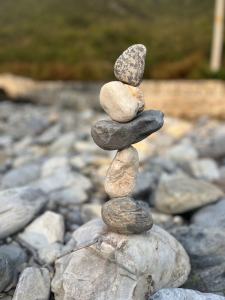
WOAH?

Das chinesische Gedicht war zuerst da.
维马丁 ist mein chinesischer Name. Weh Mahding, so klingt es ungefähr. Martin Winter auf Deutsch oder Englisch.

Alles andere geht so:

Wo 我

Wo daodi shi shenme ren
zenmeyang de ren
Guo 锅 daodi shi shenme ren
zenmeyang de ren
Woniu daodi
shi shenme ren
zenmeyang de ren
….

Auf Chinesisch ist jedes Zeichen eine Silbe. Zwischen den Wörtern in einem Satz gibt es Abstände, auf Deutsch oder auf Englisch etc., aber nicht auf Chinesisch, außer hier oben in der Umschrift. 我 wo bedeutet ‘ich’. 我到底是什么人, das ist die erste Zeile auf Chinesisch. 锅到底是什么人, das ist die dritte Zeile. Statt 我 ‘wo’ steht am Anfang 锅 ‘guo’.

Wo, oder eher ‘Woah’ von der Aussprache her, klingt ähnlich wie “guo”, oder auch “wok”, in der kantonesischen Aussprache. Ein Topf oder eine große hohle ostasiatische Pfanne. So ist das Gedicht entstanden, aus diesem Klang.

Woah, was ist das für ein Mensch,
was für eine Art?
Wok, was ist das für ein Mensch,
was für eine Art?

Woniu 蜗牛, oder ungefähr ‘Woahniuu’, ist eine Schnecke.

Woaniuu, was ist das für ein Mensch,
welche Art von Mensch?

Schnecke, was bist du für ein Mensch,
welche Art bist du?

Und so weiter!

Dann kommt auf Englisch “moth”, da ist auch dieses “o” oder “oah”. Nein, noch kein “sch” dazu… 🙂

Auf Chinesisch hab ich an diesem Punkt umgeschaltet. Hudie 蝴蝶, ungefähr ‘huuhdi-eh’, sind Schmetterlinge. Nichts mit ‘oah’, aber eben kleine Tiere wie Schnecken.

Chinesisch war zuerst da, Englisch auch schon am selben Tag.

Motte, was ist das für ein Mann,
welche Art von Mann?

Dann kommt die Ameise. Mayi 蚂蚁, ungefähr ‘maah-iih’.

Ameisen, was sind das für Menschen,
auf welche Art?

Nach der Ameise kommt schon ‘liegen’, oder im Liegen: Tangzhe 躺着, ungefähr tahng-dschöah.

Liegen, was sind das für Menschen, auf welche Art?

Nach liegen kommt stehen.

Stehen, das sind welche Menschen, auf welche Art?

Nach stehen kommt kriechen.

Kriechen, was sind das für Menschen, was für eine Art?

Kann ich mich bitte zuerst ausruhen?

Kann ich es bitte morgen sagen?

Oder nächste Woche?

Kann ich bitte ein bisschen warten,
ein bisschen
warten?
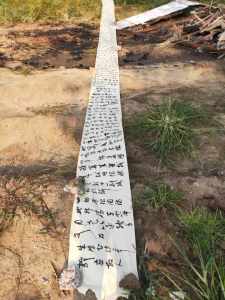
ICH

Was bin ich für ein Mensch,
welche Art von Mensch?
Was ist der Topf für ein Mensch,
welche Art von Mensch?
Was ist die Schnecke für ein Mensch,
welche Art von Mensch?
Was ist der Schmetterling für ein Mensch,
welche Art von Mensch?
Was ist die Ameise für ein Mensch,
welche Art von Mensch?
Im Liegen, was bin ich für ein Mensch,
welche Art von Mensch?
Im Stehen, was bin ich für ein Mensch,
welche Art von Mensch?
Im Kriechen, was bin ich für ein Mensch,
welche Art von Mensch?
Kann ich mich bitte zuerst ausruhen?
Kann ich es bitte morgen sagen?
Oder nächste Woche?
Kann ich ein bisschen warten,
bitte ein bisschen
warten?

MW 2024-6-22
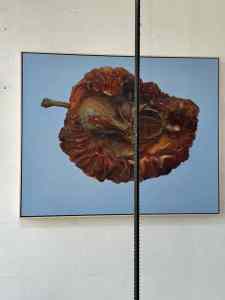
Painting by Wang Xiaoyan

我觉得什么
都不想说
锅觉得什么
都不想说
蜗牛它什么
都不想说
蝴蝶也肯定
都不想说
蚂蚁她觉得
都不想说
躺着还觉得
都不想说
站着我觉得
都不想说
爬着也觉得
都不想说
蚂蚁它能
休息再说嘛
明天再说
下周再说
等等再说嘛
就稍微
等等

2024.10
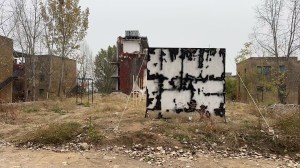
SAY

I think I don’t
want to say anything.
The pot doesn’t want
to say anything.
A snail doesn’t want
to say anything.
A moth doesn’t want
to say anything.
The ants, they don’t want
to say anything.
Lying down I don’t
want to say anything.
Standing up I do not
want to say anything.
Crawling I don’t
want to say anything.
Maybe the ant
could take a break?
Wait until tomorrow?
Wait until next week?
Maybe just wait?

MW October 2024
OUR OWN – 西毒何殇 Xidu Heshang

7月 26, 2023
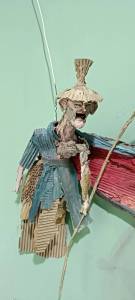
Sculpture by Tristan Tréhin

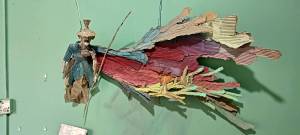
Sculpture by Tristan Tréhin

Xidu Heshang
OUR OWN

The Chinese people’s own mythological epic
The Chinese people’s own SF masterpiece
The Chinese people’s own war movies
The Chinese people’s own Band of Brothers
The Chinese people’s own Schindler’s List
The Chinese people’s own concentration camps
The Chinese people’s own massacre
The Chinese people’s own genocide
The Chinese people’s own memory of suffering
The Chinese people’s own famine
The Chinese people’s own catastrophes
The Chinese people’s own Great Dictator
The Chinese people’s own serial killers
The Chinese people’s own Natural Born Killers
The Chinese people’s own cannibals
The Chinese people’s own vampire bats
The Chinese people’s own Batman
The Chinese people’s own superheroes
The Chinese people’s own Heroic Sons and Daughters
The Chinese people’s own chained women
The Chinese people’s own Joker
The Chinese people’s own Ugly Dolls movie
The Chinese people’s own rock-‘n’-roll
The Chinese people’s own Coke
The Chinese people’s own tragedy
The Chinese people’s own shame
The Chinese people’s own homeless
The Chinese people’s own ‘no ammo, no food’
The Chinese people’s own desperation
The Chinese people’s own hand-to-mouth
The Chinese people’s own apocalypse
The Chinese people at their own home
The Chinese people cook their own food
The Chinese people make their own salt
The Chinese people drill their own wood to make fire
The Chinese people grind their own stone tools
The Chinese people walk upright on their own
The Chinese people catch and eat their own fleas

7/23/2023
Tr. MW, July 2023


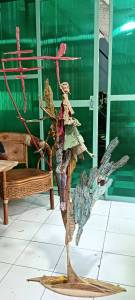
Sculpture by Tristan Tréhin

Sculpture by Tristan Tréhin

Sculpture by Tristan Tréhin

Sculpture by Tristan Tréhin

Sculpture by Tristan Tréhin

Sculpture by Tristan Tréhin

Sculpture by Tristan Tréhin

Sculpture by Tristan Tréhin


ACKERGERÄT – 简兮 Jian Xi

2月 23, 2021

Jian Xi
ACKERGERÄT

Seine doppelten Lidfalten sind ganz viele geworden,
sein Blick ist sehr unklar.
Ich rufe ihn, er reagiert nicht,
wahrscheinlich ist er schon taub.

Er war ein Ackergerät,
hat den Pflug gezogen, folgsam wie ein Ochse;
hat den Wagen gezogen, die Hufe sind alle auf einmal geflogen.

Er hat auf Hochzeiten seine Rolle gespielt,
Bräutigam hoch zu Ross, die Braut in der Sänfte.
Am Kopf rote Seide, am Rumpf bunte Farben,
er hat viel beigetragen zur Freude.

Er war ein gemütliches Spielgerät,
in einer Ecke des großen Platzes.
Reiten für Kinder, jedesmal ein paar Runden
und ein paar Fotos, pro Kopf für zehn Yuan.

Jetzt kann er nicht einmal gehen,
sogar Gras frisst er nicht mehr.
„Pferdefleisch wird sauer, Gewürze dafür“
fällt mir auf einmal ein.
Ich streichle langsam durch seine Mähne,
er hebt nicht einmal den Kopf.

Übersetzt von MW im Februar 2021

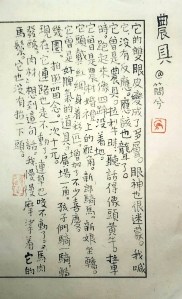
Jian Xi, geb. in den 1970er Jahren, kommt aus Changzhi, Provinz Shanxi. Lehrerin, liebt Lyrik. 《新诗典》小档案:简兮,女,七零后,山西省长治人,教师,喜欢诗歌。

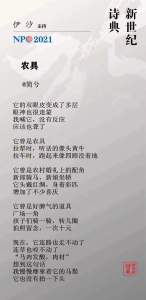
伊沙:从昨日词的陌生化到今日物的陌生化。从80后三女将到70后女”新人”,《新诗典》的编排当获最佳剪辑奖。如何完成物的陌生化?本诗告诉你:将熟悉的事物拉开一定距离,再换一个角度去看它,你将获得新的收获。

Calligraphy by Huang Kaibing

Calligraphy by Huang Kaibing

况禹点评《新诗典》简兮《农具》:马离我们的生活已经太远了,曾几何时,它不止是牲口,还是伙伴。本诗还提到了一个人们遗忘的功能——农具。这种陌生化的发生,来自于社会的发展和演变。谈不上坏,也谈不上妙,我们人类只能接受它,带着不情愿和怅然。

Calligraphy by Huang Kaibing

Calligraphy by Huang Kaibing

黄开兵:初读简兮《农具》,以为是写牛,我从小放牛,对牛有感情,但一读到“像头黄牛”时就愣了,再读,哦,原来是写马!老马!越读越让人心痛。我抄的时候,只用笔尖,但很使劲,很缓慢,很沉地摧动着笔尖,力图以最细微的线条,写出那种钝痛。

Calligraphy by Huang Kaibing

Calligraphy by Huang Kaibing


THEY TALK ABOUT LOVE – 释然 Shi Ran

12月 24, 2020

Shi Ran
THEY TALK ABOUT LOVE

The two of them are discussing love,
one is like a moth flying into the fire,
one has already been burned and wounded all over.
Finally they are turning to me,
seems like I have
what they don’t have right now.

I remember the experience
when I crawled to the birth bed
and showed my lower body,
the nurse who examined me
was baffled,
she had never thought, at my age
I would have beautiful private parts.
The scar on my abdomen told them,
this body had given birth.

I was lying there
feeling the mirror going in deeply
and the knife scraping pain,
silently grinding my teeth.
As a woman
you are going to
feel the knife, feel the knife.
Love has cooled down
and let me have
my perfect private parts.

Translated by MW, December 24, 2020

伊沙主持 | 新世纪诗典10一周联展(2020.12.20——12.26)

MITTLERE JAHRE – 独化 Du Hua

9月 9, 2020

Du Hua
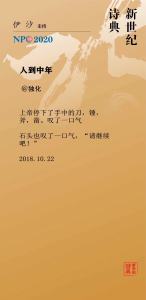
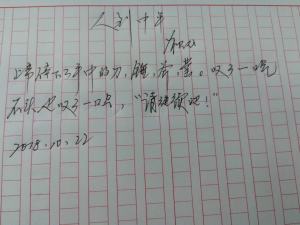
IN MITTLEREN JAHREN

Gott lässt das Messer, den Hammer, die Hacke, den Meißel
sinken. Gönnt sich einen Seufzer.

Der Stein tut auch einen Seufzer. „Macht weiter, Herr!“

22. Oktober 2018
Übersetzt von MW im September 2020


DREAM #1091 – Yi Sha 伊沙《梦(1091)》

7月 6, 2017


Yi Sha
DREAM 1091

three dreams in one night
one after the other
three blossoms opened
on the same topic:
violence

I dream of two female journalists
from Chinese Business View
they used to interview me all the time
but then I beat up a male reporter
because he stuffed sweet crumbs into my mouth
when I didn’t want it

I dream of a real
Japanese devil
seems very friendly
but there’s no need for mobilization
I want him dead
though those war films haven’t fooled me
I know killing him won’t be easy
I am preparing a saw

I dream of my roommates
at college
we move into a new place together
it’s an apartment with bathroom
I am taking a pee
someone kicks me from behind
I turn around and kick him
to the ground
almost killing him

July 2017
Tr. MW, July 2017


《梦(1091)》

伊沙

一夜三梦
梦连着梦
花开三朵
各表一枝
共享主题:暴力

我梦见两位
曾经长期采访我的
《华商报》女记者
却殴打了一位男记者
起因是他不怀好意地
朝我嘴里塞点心渣子

我梦见一位
真正的日本鬼子
貎似很善良
但无须动员
我非要弄死他
抗日神剧骗不了我
我深知弄死他不容易
我先弄来一把锯子

我梦见大学
同住一室的同学
我们一起搬入新居
是一个单元有厕所
我撒尿时
有人在背后
踹了我一脚
被我反过身来
踹翻在地
差点跺死

2017/7

ASOZIALE HANDLUNG

6月 26, 2016

Photo by Ronnie Niedermeyer, rn.co.at

Photo by Ronnie Niedermeyer, rn.co.at

ASOZIALE HANDLUNG

welche asoziale papierhandlung
welche asoziale eisenhandlung
welche asoziale kohlenhandlung
welche asoziale getränkehandlung
welche asoziale lebensmittelhandlung
welche asoziale feuerwehr
welcher asoziale fleischhauer
welche asoziale bank
welche asoziale tankstelle
welche asoziale schule

MW Juni 2016


TANKA

laue sommernacht
kinder singen dann buffet
kirche am steinhof

lichter für tote kinder
glühwürmchen und gartenduft

MW Juni 2016

19 MIGRANT WORKERS – 侯馬

9月 15, 2015

19 Wanderarbeiter

Hou Ma
19 WANDERARBEITER

19 wanderarbeiter mit ihren schaufeln
nein, es sind fünf wanderarbeiter mit schaufeln
nein, die fünf wanderarbeiter tragen vielleicht keine schaufeln
weiß nicht, mit welchen werkzeugen arbeiten sie auf der brücke
zwei wanderarbeiter im einschlafen fahren einen lastwagen mit aushub
der laster wischt die fünf wanderarbeiter hinunter
und kracht ins geländer
die zwei eingeschlafenen wanderarbeiter und die ladung erde
begraben die anderen fünf wanderarbeiter
die rettungstruppe ist schnell zur stelle
sie engagieren 12 wanderarbeiter
12 wanderarbeiter mit ihren schaufeln
graben sehr fleißig
graben aus sieben wanderarbeiter die nicht mehr atmen

1. Oktober 2014
Übersetzt von MW im September 2015

Hou Ma
19 MIGRANT WORKERS

19 migrant workers carrying shovels
no, five migrant workers carrying shovels
no, five migrant workers maybe not carrying shovels
not sure which tools they are using up on the bridge
two migrant workers dozing driving a truck with loose earth
truck sweeping five migrant workers down from the bridge
and crashing the railing
two dozing migrant workers along with their truck of loose earth
falling and burying five migrant workers
rescue team comes very fast
engaging 12 migrant workers
12 migrant workers arrive with their shovels
working furiously
very soon they dig out seven
not-breathing migrant workers

10/1/14
Tr. MW, 2015