wir waren wirklich sehr viele
in scharen sind sie
in die u-bahn gegangen
am parlament
und der heldenplatz
war auch noch voll
stundenlang stehen
am westbahnhof
oder irgendwie ausruhen
bis etwas weitergeht
außer du bist ganz vorn
die mariahilferstraße runter
also die ganze strecke
von westbahnhof bis heldenplatz
war gleichzeitig demo
es war wirklich so schön
wie 2015 anfang oktober
damals hätte noch alles
gut werden können
jetzt haben wir
wenigstens einen präsidenten
der zu flüchtlingen hält
obwohl er lächelnd
nazifreunde anlobt
es war winter
es hat geregnet
am ende war ich schon ziemlich nass
aber die u-bahn war ja nicht weit
und wir waren wirklich sehr viele
Heute ist der neunte Jahrestag der “Charta 08”. Am 8. Dezember 2008 um 11 Uhr abends drängte sich eine Horde von Polizisten vor der Wohnung von Liu Xiaobo und Liu Xia. Sie hämmerten an die Tür. Liu Xiaobo stand vom Computer auf und rief Liu Xia zu: “Schnell, du musst telefonieren!” Aber Liu Xia telefonierte nicht oft. Es war nicht genug Zeit, sie hatten kaum eine Minute. Sie sagte: “Xiaobo, mach die Tür auf.”
Sie hatte es längst geahnt. Und ihn immer wieder gewarnt.
Xiaobo wurde mit einem dunklen Tuch über den Augen abgeführt. Über einen Monat später führte man Liu Xia in benommenem Zustand in ein Hotel. Dort wartete Liu Xiaobo, man hatte ihn von einem anderen Ort, den er nicht kannte, in dieses streng abgetrennte Zimmer gebracht.
Lieber Freund, du hast uns verlassen. In der Dunkelheit, in der man seine eigenen fünf Finger nicht sieht, hast du noch einen Streifen Licht gesehen. Du hast es stotternd betont: “Ich seh, seh, seh Licht.” Wir haben es nicht gesehen. Liu Xia sagt, sie hat es auch nicht gesehen. Ihre letzte Serie von Fotographien heißt “Einsame Gestirne”. Du, ich, wir, sie, alles einsame Sterne.
Ganz am Ende sind deine Beine auf und ab, auf und ab gegangen, ununterbrochen. Nach über einer Stunde haben Atem und Puls plötzlich ausgesetzt.
Du bist auf dem einsamen Stern dort. Und die Bücher, die Liu Xia in diesen Jahren für dich gekauft hat, die liegen noch im Schrank. Was dir am meisten Leid getan hat, war dass Liu Xia nicht ausreisen konnte, dass sie ihre Freiheit nicht finden konnte. Deshalb schreibe ich diese Zeilen, und mache noch einen Appell.
Ich hoffe, dass die chinesische Regierung aus Gründen der Humanität und des Gesetzes einen Menschen frei lässt, der niemals irgendeines Verbrechens beschuldigt wurde, und der an schwerer Depression leidet. Ich hoffe, dass die Regierungen von Deutschland, Frankreich, USA und alle demokratischen Länder sich dafür einsetzen, und alle Menschenrechtsorganisationen und Aktivisten. Für die Freiheit der Witwe des Friedensnobelpreisträgers von 2010. Vielen Dank Ihnen allen!
Liao Yiwu
Schriftsteller im Exil, Friedenspreisträger des Deutschen Buchhandels 2012
8.12. 2017
Anmerkung: Liu Xias Gedicht an Herta Müller wurde am 16. Dezember von der Frankfurter Allgemeinen Zeitung (FAZ) auf Deutsch zuerst veröffentlicht.
Liu Xia:
Liebe Herta,
Ich roll mich zusammen und mach mich klein,
denn jemand hat an meine Tür geklopft.
Mein Hals wird schon hart,
aber ich kann nicht hinaus.
Ich red mit mir selbst,
ich werd verrückt.
Ich bin so einsam,
ich hab kein Recht zu sprechen,
ich darf nicht laut werden.
Ich leb wie eine Pflanze,
und lieg da wie eine Leiche.
Übersetzt von Martin Winter
My Appeal ( 我的呼籲 ):中文在後
Today is the ninth anniversary of “Charter ‘08”. At eleven o’clock at night on the 8th of December 2008, a hoard of police officers flocked towards the home of Liu Xiaobo and Liu Xia. As the pounding on the door resounded through their home, Xiaobo got to his feet in front of his computer and shouted to Liu Xia: “Quick, make the call!” But Liu Xia normally didn’t use a phone…. There was no time. Liu Xia said: “Open the door, Xiaobo.”
She’d long had a premonition. And warned him often….
Xiaobo was led off with a black cloth over his eyes. Over a month later, a disoriented Liu Xia was taken to a hotel where they met again in a sealed room. Xiaobo was brought there from a place he did not know.
My dear friend, you’ve gone. In a darkness so black I can’t see the fingers of my extended hand, you could yet see a trace of light. You always insisted in a stammer: “I see, see, see it.” We didn’t see. Liu Xia says she also did not see. Her most recent group of photographs is called “Solitary Planets”, you, me, us, her, all solitary planets.
On the verge of departure, your two legs were moving up and down, ceaselessly, ceaselessly walking. Up until an hour or so later, till your breath and pulse abruptly halt.
You’re on that solitary planet. And the books Liu Xia bought you these last few years still lie in the bookcase. Your greatest regret was that Liu Xia was unable to leave the country, could not find the freedom that was properly hers. And so I write these words and publicly appeal for her freedom once more.
I hope the government of China, out of basic human decency and in accordance with the law, will release a person suffering deeply from depression who has never broken a law. I hope that Germany, the United States, France, Great Britain and other Western governments, human rights organizations and activists would continue to negotiate with the government of China for the freedom of the widow of the 2010 Nobel Peace Prize laureate.
Thank you all.
Liao Yiwu,
Writer in exile, recipient of the 2012 German Book Industry Peace Prize
Translated by Michael Day
———————————-
Dear Herta
I curl into a ball
As somebody knocks at the door
My neck starts to stiffen
But I can not leave
I speak to myself
I’m going mad
Too solitary
I have not the right to speech
To speak loudly
I live like a plant
I lie like a corpse
The only war I know
to be called great
is not the Trojan War
nor the Soviet Union’s Great Patriotic War
nor our eight-year Resistance Against Japan
but rather that recent thing between China and India
induced by border friction.
Like children play house, they throw rocks at each other,
fall down a few times,
then just call it quits.
Zero casualties on both sides.
2017
Translated by MW, November 2017
Ma Fei GROSSER KRIEG
Der einzige große Krieg
den ich kenne
ist weder der Trojanische Krieg
noch der Große Vaterländische Krieg der Sowjetunion
noch unser achtjähriger Verteidigungskrieg gegen Japan
sondern unlängst der Streit zwischen China und Indien,
verursacht von Spannungen an der Grenze.
Wie Kinder, die spielen und Steine werfen,
ein paarmal hinfallen, dann einfach heimgehen.
Verluste auf beiden Seiten sind null.
5oo jahre glauben
500 jahre reformation
sieben jahre gar nichts mehr glauben
jedenfalls in österreich
jedenfalls an österreich
außer im widerstand
im kz
im himmel
also 493
oder was
aber
evangelisch
ist so minderheit in österreich
dass man/frau/kind
sowieso gedenkt
oder nicht
ob martin luther
gelebt hat
oder gestorben ist
oder beides
ist nicht besonders wichtig
für mich persönlich
martin luther king
war sehr sehr wichtig
und der vor 500 jahren
hat eine sehr wichtige bibel geschrieben
die immer noch gut klingt
und er war wichtig für widerstand
obwohl dann gegen bauern
und in der hinsicht ist er mir
eh auch nicht wurscht.
MW Oktober 2017
TAROCK
wir spielen um geld
weniger als ein euro
wenn du zehn cent gewinnst
an einem abend
ist es sehr schön
wenn du verlierst
ist es auch nicht so schlimm
hauptsache wir treffen uns
am ende der woche
egal wie die wahl war
in der bibliothek
die bibliothek
ist das schönste am haus
wir spielen um geld
du denkst nur an die karten
es gibt ein bisschen weißwein
vielleicht knabberzeug
manchmal wird auch geredet
manchmal gibt es essen
hauptsache es wird noch gespielt
you are not going to find out
or people won’t know
what happens after you die
or I for that matter
we aren’t important enough
but even with those who are
no-one really knows
MW October 2017
SEI GETROST
du wirst es nicht herausfinden
oder es wird nicht bekannt
was passiert wenn du tot bist
oder ich
wir sind nicht wichtig genug
aber auch bei den wichtigen
weiß mans nicht wirklich
austrian national day
2017
it’s a beautiful day
we stand in line on heroes’ square
along the castle
to get into the president’s quarters
next to us in line
is a guy from syria
his german is very good
he hands me his phone
what he writes in german
sounds like 19th century
but it’s clear and correct
a small scrawny guy
don’t know if his family
is still in syria
at least he can stay
there are 12 words or more
for love in arabic
translating himself
into german or english
he feels rather clumsy
going inside the imperial palace
the president’s office
security is not very strict
our guide from the offfice
in her typical
austrian diction
sounds proud and detached
and somewhat ironic
at the same time
we don’t catch the president
but we see the empress
she looks ordinary
the most powerful woman
maria theresia
now this is the room
where the president receives the government
yes, it’s much smaller than on tv
there was heating inside the building
in imperial times
the whole middle tract
air going up and down
all the way to the basement
very advanced for the time
only one room
has a fireplace
they had 15 degrees in this room
15 celsius in winter
this was the warmest place in the building
largest castle in europe
national day, austrian army
the atmosphere is rather relaxed
tee and good music
for everyone
in the president’s courtyard
regional army band, very good jazz
and of course strauss
children climbing
national monuments
austrian national day
nothing to brag about
at least the president
is not a german nationalist
last year wasn’t easy
all those elections
this year is much worse
next year those fuckers
will be in government
it was a nice national day
it’s a beautiful country
es ist alles sehr kompliziert
was nicht kompliziert ist
ist dass man die blaunen
viel viel viel zu lange
toleriert und gefördert hat
gesetze als ausländerhetze
ich hab spö gewählt
gegen schlatzblaun
häupl war sehr lange aufrecht
und ist es noch
spö in der opposition
warum nicht
spö mit der neonazi-partei?
lieber schlatzblaun
und ein bisschen nachdenken
und widerstand
Picture by Andreas Luf, inspired by Thelonious Monk’s “Underground”
REPORT
every report
every detailed incisive report
kind that makes powerful people squirm
is just as important
as any art
any poem
any church, temple
that makes you pause
think
feel
every report
MW February 2017
POETRY
poetry
is impo
rtant
truth
is impo
tent
or is it
or are you
strongman, he is not a bird
strongman, he is not a plane
what is strongman all about?
strongman makes it strong for you
strongman, he makes all the shots
strongman, he makes all the drinks
strongman, he makes every sauce
strongman, chairman get along
strongman makes you extra strong
makes you swallow his strongsong
don’t tell me you didn’t know
he is not here
for he is risen
he’s not here with us
with our eggs
in our nests
with our bunnies
maybe he is
in idomeni
somewhere on the road
let’s make austria strong
say the people
who seal the borders
the eagle is not beautiful
the shadow of the eagle is
they have a chapel for Katyn
across from uprising square
the uprising was very brave
they won at first
the Red Army was there
just across the river
but the Red Army waited
then the Germans came back
they razed Warsaw City
the Red Army waited
that was in 1944
before that was the Ghetto
the Ghetto uprising
Stalin’ s culture palace stands in its place
in the place of the Ghetto
Katyn
was in 1940
tens of thousands of Polish officers
killed by Soviet intelligence
Ukrainians too
they have a chapel for Katyn
across from Uprising Square
tens of thousands of names
and a beautiful eagle
they say
I like its shadow
MW July 2015
SUNSHINE IN WARSAW
Jacqueline Winter
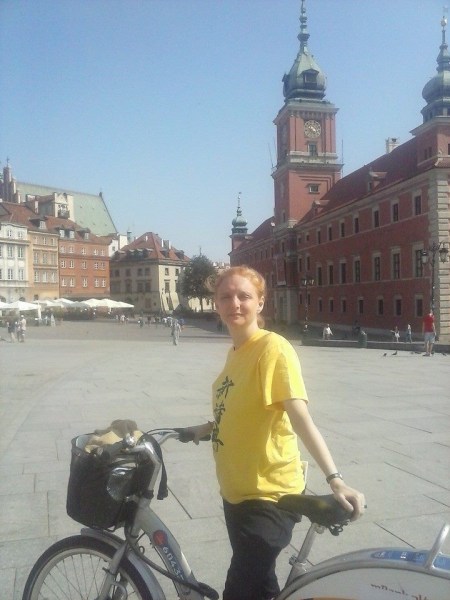
A beautiful summer morning. Biking through the historical center. The bike return station is next to the monument of the 1944 uprising against the Nazis. HOW many dead and wounded, while the Red Army literally stood by on the outskirts of town? And the city dynamited and emptied of its population…you would never think it, looking at it now.
Across the street, inside a church, a simple and gut- wrenching memorial to the Katyn massacre victims. With a side memorial for the Smolensk plane crash of 2010, which I fail to understand. Must ask a local where they see the connection- if they do.
And what a tough people: exiled, murdered, bombed, map redrawn…yet they rebuilt splendidly from the rubble while still dirt- poor and were the first to put up meaningful nonviolent resistance to the Soviets back in 1980. And had free elections as soon as they could.
Swinoujscie – Swinemünde had public exhibits around town about their common history with Germany, bilingual. A strongly German city which was bombed flat 55% for being a naval base. No mention of the pre-war German population in Warsaw, though…
The Warsaw “Stalin cake” / Palace of Culture and Science is still on the grounds of the Jewish ghetto. That uprising was in 1943. A few meters of markings on the ground to show where its outer wall once stood. That is all.
ATTITUDE, EMPATHY AND SO ON
Martin Winter
People are trying to get by everywhere. First World vs. Third World (or Second World) creates issues of privilege. Just like different kinds of background, experience, heritage make for issues of disconnect within a common country or region. Why are people stupid enough to vote for or even work with racist rightist arseholes in Hitler-spawning Austria? Austria-Hungary-Germany whatever? My friends in China try to get by. Like people everywhere. Some get to express how they detest the state they are in. Some more than others. Like people anywhere, more or less. Some have their audience, as famous poets or fiction writers. Yes, things have improved very much in Taiwan, and in China there is the same repression going on in some ways. Yes, everyone is taking part more or less, including foreigners. All in all, foreign media is a good influence. Most of it. Everywhere probably, in every country, reporting from any outsider’s stance or background can be very refreshing. I was privileged in Taiwan and in China, in Eastern Europe, even in America. On the other hand, I am in between. Every day I talk and work with people and texts from different worlds. It’s a great life, all in all.
die erde bebt
als ob der himmel brennt
walter
du stehst am brückenkopf
hörst die kirchenglocken
ein schlag nach dem andern
unter den parteistandarten
die altstadt ein haufen ruinen
walter
du weißt was du gebrauchst
ist nicht mehr ein kennwort
was verteidigt werden muss
ist auch nicht nur
der boden
es ist der wind
ob er durchwehen kann
die gassen in feindeshand
zwischen verlassenen
häusern hindurch
auch wenn nur eine
eidechse überbleibt
spricht sie serbokroatisch
vielleicht bleiben nach einer explosion
nur noch kreisende mücken
aber du musst dich dennoch anzünden
walter walter
die erde bebt
als ob der himmel brennt
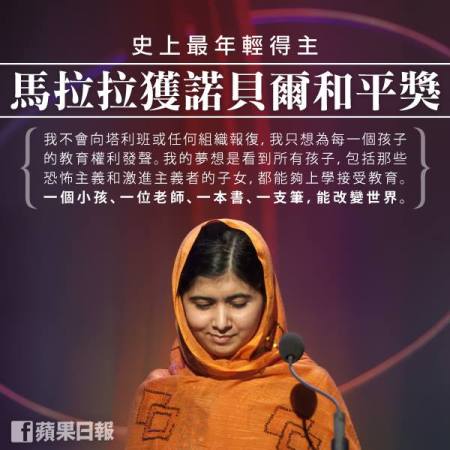
Am liebsten würde ich ein ganzes Heft gestalten. Das Cover. Malala gewinnt den Friedensnobelpreis. Apple Daily in Hongkong. Malalas Kopf, rundherum alles Chinesisch.
“Ich möchte weder Rache an den Taliban, noch an irgendeiner anderen Organisation. Ich möchte meine Stimme nur dafür erheben, dass jedes Kind ein Recht auf Unterricht hat. Mein Traum ist, dass alle Kinder, auch die Söhne und Töchter der Terroristen und Radikalen, in die Schule gehen können und Bildung bekommen. Ein Kind, ein Lehrer, ein Buch, ein Stift – kann die Welt verändern.” Hat sie das wirklich gesagt? Ich habe mir ihre Rede angeschaut, auf Youtube. Englisch, Urdu, Pashto. Auf der Bühne mit ihrer Familie. Ihr Bruder, ihre Eltern. Der Bruder wird neidisch sein. Sie bemüht sich sehr um Harmonie, ist wirklich froh, dass auch jemand aus Indien gewonnen hat, der für Kinderrechte einsteht.
Dieses Cover. Nur das Bild. Foto: Apple Daily. Das ist auch schon ein Hinweis auf die Proteste in Hongkong von August bis Dezember 2014. In den USA gab es auch Proteste, für Bürgerrechte, in der Nachfolge von Martin Luther King. Und in Österreich meldet wenigstens das Gratisblatt “Österreich” wieder einmal, dass Strache als Neo-Nazi im Gefängnis war. Strache heißt Furcht und Schrecken. Graz heißt Stadt. Eine wichtige Stadt für die Literatur. Eine gar nicht so heimliche Hauptstadt, zu manchen Zeiten. Für den Schrecken. Für die Literatur, etwas später. Yi Sha 伊沙, der am 17. März in Graz seine Texte vorstellt, die in manchem an Ernst Jandl erinnern, kommt aus Xi’an 西安. Hauptstadt schon vor über 2000 Jahren. Terrakottakrieger. Tang-Gedichte. Von daher kommt Gustav Mahlers Lied von der Erde.
Eine wilde Mischung. Sich der Gewalt stellen. Respekt geben, zeigen, und damit auch fordern. Haben sie das gemeinsam? Yang Lian 楊煉, ein großer Dichter, aktiv und engagiert seit den 1970er Jahren. Liu Zhenyun 刘震云, bis vor zwei Jahren vielleicht bekannter als Mo Yan, auf jeden Fall unterhaltsamer. Richard Claydermann und die Trommeln in den Bergen. Klingt vielleicht eskapistisch. Aber Liu Zhenyun geht es um Aufarbeitung, und um Respekt für die kleinen Leute. Er kommt aus einem armen Dorf und ging zur Armee, um schreiben zu können – wie auch Mo Yan 莫言 und manche andere.
Respekt zeigen, und damit einfordern. Zheng Xiaoqiong 郑小琼 tritt auch am 17. März in Graz auf. Ihre Texte kommen aus den Fabriken in Dongguan. Das ist im Perlflussdelta, nicht weit von Kanton 広州, Hongkong 香港 und Shenzhen 深圳. Xu Lizhi 许立志 sprang in Shenzhen in seinen Tod. Bei Foxconn 富士康, wo sich schon viele Arbeiter und Arbeiterinnen umgebracht haben. Foxconn fertigt Computer und Telefone für Apple. Xu Lizhi war ein sehr begabter Dichter. Bei Zheng Xiaoqiong kommen viele Kolleginnen vor, die nicht mehr am Leben sind. Oft wegen Unfällen. Viele sind auch verschwunden.
Respekt zeigen, und Hoffnung geben. Wie Malala. Viele Frauen sind in diesem Dossier, verglichen mit anderen Kunstsammlungen, nicht nur chinesischen. Fünf Frauen, von elf Autorinnen. Zwei mit Prosatexten. Zheng Xiaoqiong hat sehr gute Reportagen geschrieben, leider habe ich bis zum Redaktionsschluss noch keine fertig übersetzt. Aber von Zheng Xiaoqiong kommt bald ein Buch in Österreich heraus, mit Reportagen und Gedichten. Bei FabrikTransit. Und in Wien gibt es am 20 März am Ostasieninstitut der Universität Wien einen Workshop mit Zheng Xiaoqiong, auf der Grundlage von einer Reportage und anderen Texten. Und eine Lesung gibt es, veranstaltet vom Institut für Sprachkunst der Universität für Angewandte Kunst.
Hao Jingfangs 郝景芳 Science-Fiction-Geschichte ist der längste Text in diesem Dossier. Widerstand. Wie ist Widerstand möglich, wenn aller Widerstand gegen den Staat längst gebrochen wurde?
Kaufen Sie das Heft, lesen Sie, wie es geht. Oder lesen Sie von Ma Lans 马兰 ”Doppeluterus“, und unerklärlichen Spuren im Schnee. Von Liu Xias 刘霞 Charlotte Salomon. Soll noch einer sagen, chinesische Literatur sei nur über China. Alle Beiträge reden über Respekt, und über Rechte. Sehr allgemein.
Li Yunqi
LEADER, HOW COME YOU BECAME A CRIMINAL MONSTER?
— surprised to see security chief Zhou Yongkang reduced to a prisoner
For a long time, you were our leader.
On the chairman’s pedestal,
you stood tall and strong.
On the TV screen,
your vigor was shining.
Your voice carried strength,
you were sound as a bell.
You fought against crime,
you were unforgiving.
When you held the reins,
to protect law and justice for our nation,
every man on the street stood behind you.
Now I know, you became a criminal
only because you lost your power.
If you were still up in control,
no-one could do anything,
no-one would ever dare raise his voice.
Every ounce of a doubt
would have been slander.
Every one not behind you
would be against you.
Each one resisting
would be a traitor.
When you were up and running,
who gave you the highest place at the top?
And when you lost power,
who made you a stinking criminal monster?
Black and white, right and wrong,
Great leader and criminal,
it was all very sudden.
If you held onto crime and controlled justice,
should I believe fairness rules in society?
If greed led you all the way to the peaks,
should I believe in a value system?
How about people judged criminals by the criminal,
are they endangering our nation?
How long will it take till we won’t hear any lie in the media?
How long until power isn’t a wrestling driven by greed?
When will it be that my hand,
a small helpless hand,
becomes a shield to cut off crime when it spreads?
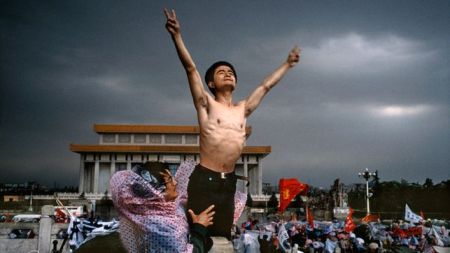
There were demonstrations in Vienna yesterday. I went during the day, but in the evening I was too tired. It was important in the evening, of course. They let far-right organizations march through the city, canvass at universities and so on, aggressively protected by police. Anti-fascist protesters have a hard stand. Police brutality is fatal sometimes. A young subway sprayer was beaten into a coma by Wiener Linien public transport security and police in early April, and has not woken up since then. In the evening of June 3rd, the East Asian Studies department at Vienna university held an open discussion. The most interesting thing was three young female students who had interviewed Fang Zheng 方政 via Skype. He was that athlete whose legs were severed by a tank when he helped a female student get out of the way in the morning of June 4th, 1989. He became a disabled athlete and set records. But they were always worried he would get too much publicity, so he was barred from some international events. He kept quiet during the Olympics in 2008, so that he would get his passport and could leave in 2009. Lives in San Francisco, chairs an exile organization there. That presentation was great. The North Korea specialist made some interesting remarks, and in the end a Chinese professor finally made a brief personal statement. Vienna University vice president Prof. Weigelin-Schwiedrzik asked the students present what they would have done, if they would have stayed on the square under the threat of martial law. It is a romantic question – the protests in 1989 are always romanticized, as if it had been one great student party. Students took the lead, but the most important thing about any nationwide protest is popular participation, workers and many common people, not elites. Same with Taiwan’s recent Sunflower Movement. Anyway, I raised my hand and said I could not know what I would have done. Several people said so. I said I was in Taiwan in 1989, they also had demonstrations, with different aims. The February 28th, 1947 massacre in Taiwan had not yet been acknowledged. What I should have said when I raised my hand was that everyone present should think about taking part in the anti-fascist protests the next day in Vienna, on June 4th, 2014.
ein vogel sein
ein vogel im baum
im baum auf der mauer
auf der mauer am fluss
in der sonne im november
ein vogel sein
eine ente im fluss
ein schmetterling
ein löwenzahn
oder ein mann
oder ein großer glänzender baum
györ ist eine schöne stadt
das essen ist köstlich
die therme ist herrlich
es gibt ein wunderschönes konzerthaus
was du ererbt hast von deinen vätern
erwirb es um es zu besitzen
ein schönes konzerthaus
ererbt von den toten
eine große synagoge
ein modernes konzerthaus
fast so groß wie das in wien
nur ohne deutschtum an der fassade
vielleicht spielen sie auch wagner
in der schule an der seite
existiert eine kleine gemeinde
aus dieser kleinstadt
wurden 5000 in ausschwitz vergast
auch viele kinder
györ ist eine schöne stadt
es gibt ein theater mit vasarely
an der fassade vorne und hinten
von oben wirkt es wie eine schanze
vom turm des priesterseminars
eine chance für die kultur
wir sahen ein wunderschönes ballett
mendelssohns sommernachtstraum
sokrates sagte in politeia
es brauche eine gemeinde
eine stadt beschützt von den göttern
von etwas gutem
etwas gedacht als gütige gottheit
gott der gerechten
es gibt die kirchen
es gab auch märtyrer unter den priestern
der bischof beschützte frauen im keller
und wurde erschossen
sokrates sagte in politeia
dass ein einzelner gerecht sei
sei nicht begründet
in einzelnen menschen
sondern in der ganzen gemeinde
in einem gott der ganzen stadt
was du ererbt hast von deinen vätern
erwirb es um es zu besitzen
ererbt von den toten
trebic und györ
mikulov und kosice
friedhof altstadt synagoge
viele juden fielen im weltkrieg
im ersten weltkrieg
für österreich-ungarn
oder für deutschland
was 1944 geschah
deportation und dann die bomben
das leben danach
in kleinen städten ist es recht deutlich
györ ist eine schöne stadt
das essen ist köstlich
die therme ist herrlich
es gibt ein wunderschönes konzerthaus
Chat with an old friend in Beijing who works in Chinese media. Thursday, Feb. 28, 2013 7:50 am GMT
hello dear
bonjour. 早上好。
how are you ??
還可以
你好嗎?
空氣很臭嗎?
feeling nauseated, pollution is above maximum level again 855 right now
他們兩會喘氣一點也好
disgusting
+o(
you know the article i translated a few days ago to tackle the pollution? they want to forbid the barbecues !!
*^o)
like 羊肉串?
dui !!
太可笑
可悲
the state of the air is the state of the art of ruling the country. we had a guy from shanghai here at the university yesterday, there is a un conference on middle east in the city, and he is a chinese expert on jews in china and relations to middle east. very pragmatic, realist guy, sounds like some of his israeli friends. we don’t want another libya chaos, so we veto.
😐
but who are they defending in the security council? sudan was massacring their own people. China supports any regime that suppresses their own population by military means.
yeaah, so now it is too late for the international community to shine, and the ones who help in Syria are the radical islamist, Al qaida etc..
exactly.
when the war will be over, do we really want an other country ruled by Al Qaida, because china did not want chaos ? such short term vision lets not forget the dearest firend poutine such a nice guy to help his economy by boosting the weapons and jets industry
yes. the chinese love to cooperate on weapons with israel and do all sorts of research. he likes to talk about such things. but nobody asked tough questions. stephane hessel died two days ago in france, wasn’t it? the old guy who survived the nazis and inspired recent civil movements. it’s not easy. arab spring was risky. doesn’t look good now, on the whole.
yes, he passed away, just learned about it a few minutes ago, i just cried watching the news
every revolution takes time, the french one lasted more than 20 years to really settle down
the name arab spring comes from prague spring 1968. there are always risks with popular movements for democracy from the bottom up. participation, human rights, civil rights, civil society.
but the good thing in the chaos in egypt and algeria and tunisia, is that now, people know they can make a difference, and wont take bullshit and abuse like sheep
so, all those who just had personal ambitions are aware that they too can be put down by civilians if they don t act according with the will of the people.
yes. two and a half years ago it looked like mubarak and gaddafi etc. would rule forever.
it will take time, but in the end, we, the basic people all want the same: quiet, freedom, work, and education for the kids
it was more convenient for everybody to support the status quo.
for us, china, eu, diplomats….
you are right. to be left in peace by the government, to have basic rights and freedom, to have work, and education for the kids. in tibetan. in mongolian. in uighur. etc. not very difficult.
it’s very disgusting. the poem is from last october. it didn’t look as if she would get justice. remarkably well-written report in the newspaper when you follow the link., very detailed.
my chinese is too bad to understand the original text, but i will have some of my colleagues help me understand. I am getting ready for the NPA and CCPPC. 3 weeks with no day of for this occasion.
at austrian PEN-club they have a special activity Time To Say No. Started after Malala was shot in Pakistan. I am helping them with Chinese texts. http://www.penclub.at/
One Chinese writer who lives in Canada sent a much more horrible poem than Lily’s Story. Very good poem, too. Her name is Sheng Xue 盛雪. I can send it to you, if you like. Women’s day on March 8 is a good occasion to pay attention to the real world.
yes, please, it is always good to make people aware of these facts
too many people with power still think they can get away from their acts, thank god internet is there so nobody forgets
i can’t stand that these murderous pigs can get away with it !!
i am not for violence, but sometimes i think …
:@
please send it around, if you like.
i will
the english translation is not bad. but the original is even better.
or worse, of course.
i passed them around
what are your colleagues saying? Maybe they know some of the names in the poem by Sheng Xue. I didn’t know the names, but it sounds very real.
i did not hear anything from my colleagues
i guess many chinese just prefer to ignore that kind of things
like the ostrich digging its head in the sand
at least one or two of the names in the poem by Sheng Xue would get results even in English at Google or Baidu. Lily’s Story was reported in China. Even in newspapers, though not very big.
i think the more they hear about this kind of things, the more rebellious they will be towards those jerks
yes. but it isn’t big news every day. the pollution is. that’s the good thing about it. easy to say for me when I don’t smell it right now.
sie haben den baum vorm fenster gefällt
ich weiss nicht warum
er liegt noch herum
sie standen beisammen im hof und sprachen
von polizei und so sachen
ich fragte nicht nach
wir sind nachbarn im anderen haus
es geht uns nichts an
es war nur der baum
unlängst haben sie sträucher gerodet
da ist eine gesprungen
und eine weile liegengeblieben
hat man dann erfahren
sie haben den baum vorm fenster gefällt
es steht noch ein kleiner gestutzter
und bald kommt der efeu der wilde wein
und was rotes das klettert
und noch weisse sträucher
der baum war alt
er hat halt geblüht
von uns aus gesehen das schönste im hof
jetzt gibt es mehr licht
man sieht in der richtung die serbische kirche
und weniger nester vielleicht
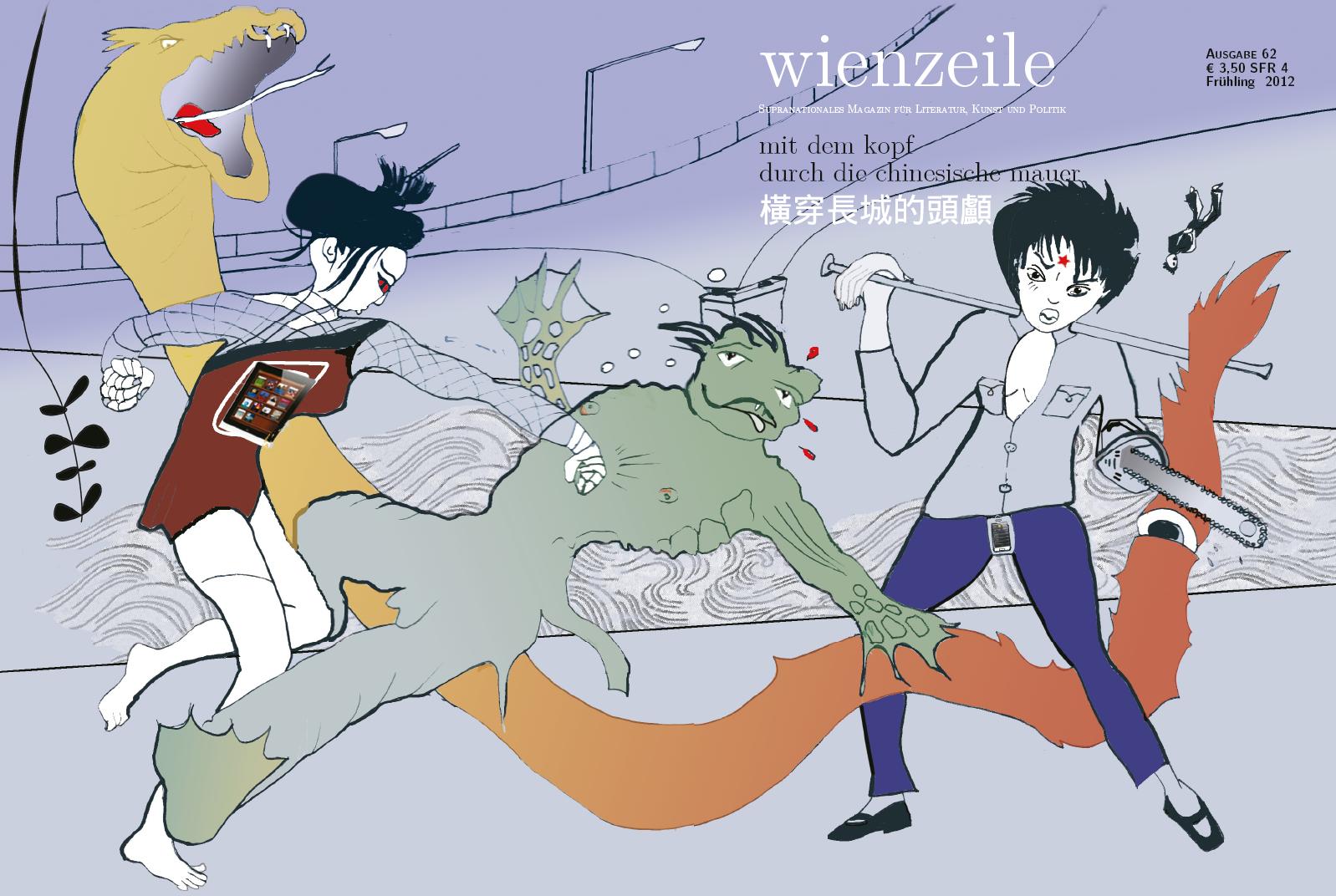
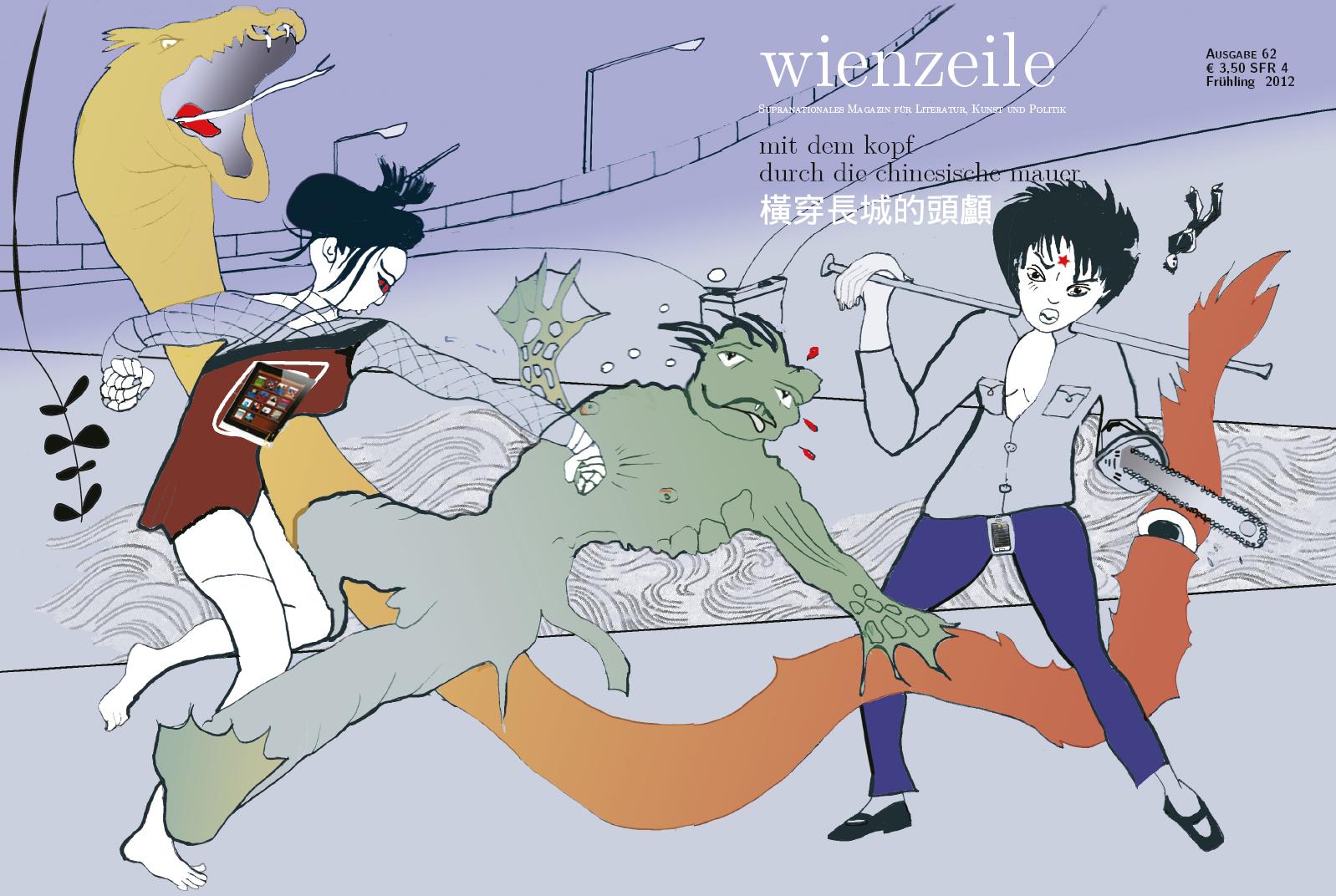
Die Nummer 62 des Literaturmagazins “Wienzeile” ist gedruckt! Mit Texten von Hsia Yü 夏宇, Yan Jun 顏峻, Hung Hung 鴻鴻, Zheng Xiaoqiong 鄭小瓊, Yu Jian 于堅, Ma Lan 馬蘭, Qi Ge 七格, Wu Yinning 吳音寧, Lin Weifu 林維甫, Tong Yali 彤雅立, Pang Pei 厖培, Liao Yiwu 廖亦武 und vielen anderen. Dazu gibt es Grafik und Bilder von Yang Jinsong 楊勁松, Chen Xi 陳熹, Emy Ya 葉宛玲, Ursula Wolte und anderen mehr.
Wu Yinning 吳音寧, Hsia Yü 夏宇, Hung Hung 鴻鴻 und mehrere andere SchriftstellerInnen und KünstlerInnen in dieser Nummer sind aus Taiwan. Gedichte von Wu Yining gibt es auch hier. Zwei der sieben Gedichte, die ich von ihr übersetzt habe, zitieren taiwanische Rockmusik. Eines ist über einen Kanalarbeiter. Die lokalen Details in Verbindung mit Wu Yinnings starkem sozialen Engagement machen die Faszination aller ihrer Texte aus. Sie war z.B. 2001 in Chiapas in Mexico und berichtete von der zapatistischen Revolte.
Wir haben Texte über Wahlen und Demokratie, 1979 – zur Zeit der Demokratiemauer – und heute. Helmut Opletal, langjähriger Rundfunk- und Fernsehkorrespondent, berichtet von den politischen Verhältnissen im Peking der Demokratiemauer und zieht Vergleiche mit aktuellen Ereignissen. Wir haben Han Hans 韓寒 Essay über Demokratie, übersetzt von Ingrid Fischer-Schreiber. Das ist einer von drei Texten – über Revolution, Demokratie und über Freiheit- die Ende Dezember 2011 herauskamen, gerade als wieder einige Dissidenten zu hohen Freiheitsstrafen verurteilt wurden. Han Hans Texte wurden weltweit heftig diskutiert, unter anderem im Zusammenhang mit 100 Jahre Chinesische Revolution/ Abdankung des letzten Kaisers 1911/1912, auch bei einer großen Konferenz an der Universität Wien Anfang dieses Jahres. Wir haben einen Text des Computer- und Internetexperten Hu Yong 胡泳, ebenfalls übersetzt von Ingrid Fischer-Schreiber 殷歌麗, Kuratorin der Ars Electronica in Linz, Übersetzerin zahlreicher chinesischer Artikel und Bücher aus politisch-sozialen und wissenschaftlich-technischen Bereichen. Nicht zuletzt enthält diese Sonderausgabe einen Vergleich zweier hochbrisanter politischer Texte, der Charta 77 aus der damaligen Tschechoslowakei und der chinesischen Charta 08, erstellt von einer Politologin und Sinologin aus Tschechien.
Das Cover ist von Linda Bilda, einer Künstlerin aus Wien. Innerhalb der Redaktion war es von Anfang an umstritten. Aber eine wichtige chinesische Schriftstellerin, die in dieser Ausgabe vertreten ist, findet es gut, gerade auch wegen der Gewalt. Heutiges China, sagt sie.
Ein weiterer Punkt, der zuletzt heftig diskutiert wurde, war die Inkludierung von Texten von und über Wanderarbeiterinnen in China. Im September letzten Jahres war hier in Wien eine große Konferenz über Arbeitskonflikte in China. Vorträge und Berichte gibt es online auf den Konferenzwebseiten und bei Transform! . Eine der Vortragenden war Astrid Lipinsky vom Ostasieninstitut der Univ. Wien, die schon 2008 in der Zeitschrift Frauensolidarität über Arbeitsmigrantinnen, ihre Sprache und ihr Schreiben berichtet hat. In der Wienzeile haben wir den ersten Teil eines langen Gedichtes von Zheng Xiaoqiong 鄭小瓊. Sie ist Arbeitsmigrantin in Dongguan 東莞 und hat neben ihrer Fabrikarbeit seit ungefähr 10 Jahren viele literarische Texte veröffentlicht, die nicht nur auf dem chinesischen Festland, sondern auch in Taiwan und darüber hinaus bekannt und geschätzt sind. Für Hung Hung 鴻鴻, Regisseur und Schriftsteller in Taipeh, erinnern manche Gedichte von Zheng Xiaoqiong an “Akte 0” von Yu Jian 于堅, einem der renommiertesten chinesischen Dichter, der ebenfalls in dieser “Wienzeile” vertreten ist.
Mit dem Kopf durch die Chinesische Mauer – 橫穿長城的頭顱。Der chinesische Titel stammt von Liu Jixin 劉紀新 aus Peking. Liu Jixin unterrichtet klassisches und modernes Chinesisch am Ostasieninstitut der Universität Wien. Im jetzigen gesprochenen und geschriebenen Chinesisch sind klassische Wendungen durchaus häufig, und auch heute sind Bildung, Erziehung und Sprache in vielen Aspekten brisante Themen. Liu Jixin hat einen kleinen, recht subjektiven Artikel über Schulen in Wien und in Peking geschrieben. Die in Peking tätige Architektin Chen Ing-tse 陳穎澤 aus Taiwan schreibt über Lang- und Kurzzeichen in der chinesischen Schrift. Sie hat eine sehr prononcierte Meinung. 100 Jahre nach den ersten Ansätzen der Sprachreform, die eine enorme Kluft zwischen gesprochener und geschriebener allgemeiner Verkehrssprache und eine hohe Schriftunkundigen-Rate beseitigen wollte, gibt es auch auf dem Gebiet der Sprachen und Schriften im chinesischen Sprachraum viele aktuelle Konflikte.
Josef Goldberger interviewt eine chinesische Absolventin eines Studiums in Wien.
Wer erinnert sich noch an 1990? “Keine Mauern mehr” hieß der österreichische Beitrag zum Eurovisions-Songcontest. Leider begannen noch im selben Jahr die Jugoslawien-Kriege der 1990er Jahre, die 1999 auch China berührten, mit dem NATO-Bombardement der chinesischen Botschaft in Belgrad. Diese “Wienzeile” enthält eine Erzählung von Tamara Kesic, die 1990 in Kroatien spielt. Außerdem haben wir weitere literarische Beiträge von deutschsprachigen Autoren, etwa Gedichte von Isa Breier und einen Text von Thomas Losch.
Die Wienzeile 62 wird am 17. Mai im Venster 99 in Wien mit einer Multimedia-Lesung präsentiert (siehe Plakat). Der Dichter und Musiker Yan Jun 顏峻 tritt live auf. Die Zeitschrift ist bei der Redaktion, im Sekretariat der Abteilung Sinologie des Ostasieninstituts an der Univ. Wien und auch bei mir (Martin Winter) erhältlich.
Wienzeile, a literature magazine coming out in Vienna, Austria, with entries in Chinese, English and German. Lots of new literature by Hsia Yü 夏宇、Yan Jun 顏峻、Hung Hung 鴻鴻、Zheng Xiaoqiong 鄭小瓊、Yu Jian 于堅、Ma Lan 馬蘭、Qi Ge 七格、Wu Yinning 吳音寧、Lin Weifu 林維甫、Tong Yali 彤雅立、 Pang Pei 龐培、Liao Yiwu 廖亦武 and many others.
Art work and photos by Linda Bilda, Yang Jinsong 楊勁松, Chen Xi 陳熹, Emy Ya 葉宛玲 and others.
Articles by Han Han 韓寒 and Hu Yong 胡泳. And an article comparing Charter 08 to Charter 77, written by Helena Nejedla, Czech Republic. If you get hungry while reading, we have a recipe for 四川鍋盔.
































 中国大好き
中国大好き 