wanderwege perfekt angelegt
nach dem wandern am besten obst
in den 80er jahren hat man entdeckt
am 35. breitengrad schmeckt dieser apfel sehr süß
im falun-tempel der tang-zeit
wächst eine föhre aus der pagode
inschriften unter mao zerstört
einer sagt mao schrieb genial
ein alter mönch mag meine haare
einer sagt tianjin tausend sind tot
oder noch mehr
perfect paths to get lost
perfect crowds lead you home
as they discovered in the 1980s
35 degrees latitude is great for apples
tang dynasty falun-temple
pagoda with pine tree growing on top
inscriptions destroyed under mao
someone says mao wrote great calligraphy
some old abbot loves hair on my arms
someone says one thousand people died in tianjin
or maybe more
Qin Bazi 《全民书法》 DAS GANZE VOLK SCHREIBT KALLIGRAPHIE
mit dem pinsel auf reispapier
schreib ich mein neues gedicht ab
von links nach rechts, waagrechte zeilen
ein vers eine zeile
moderne gedichte müssen modern sein
moderne formen
ja nicht die alten nachahmen
ja nicht in dieselben geleise
ein großes rufzeichen
ein großes fragezeichen
ich schreibe und schreibe
verfalle in trance
auf einmal bin ich
in der kulturrevolution
und schreib große poster
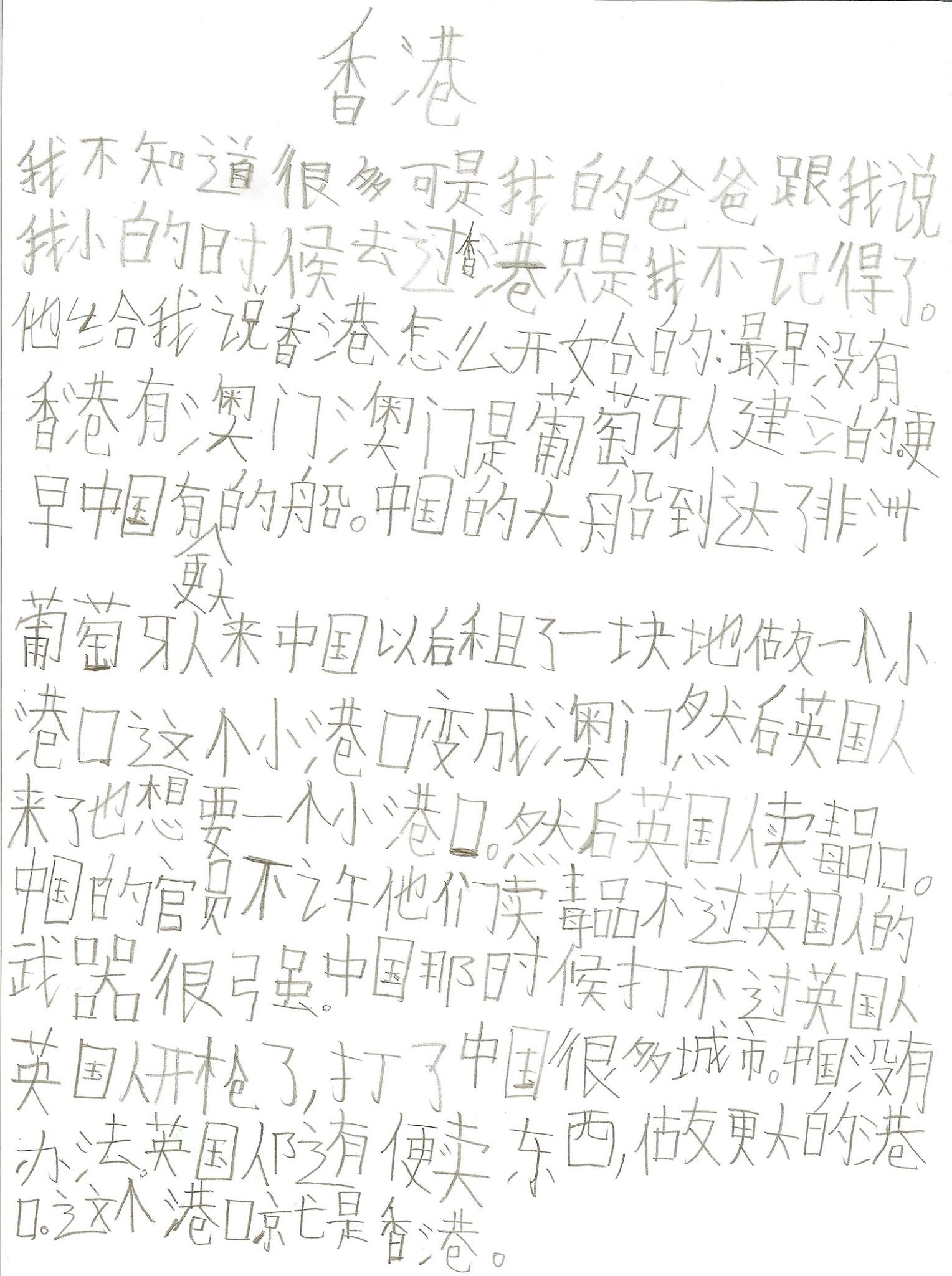
”I don’t know very much but my dad says I went to Hong Kong when I was small. But I don’t remember.
He told me how Hong Kong began: At first, there was no Hong Kong, there was Macau. Macau was established by the Portuguese. Before that China had even bigger ships that made it to Africa.
When the Portuguese came to China, they rented a small piece of land and made a small harbour. This small harbour became Macau. Then British people came and wanted another small harbour.
Later the British sold drugs. Chinese officials didn’t allow them to sell drugs. But the British had strong weapons. China could not beat them. They opened fire on many cities. China could do nothing.
The British just sold what they wanted. And built a bigger harbour. This harbour became Hong Kong.”
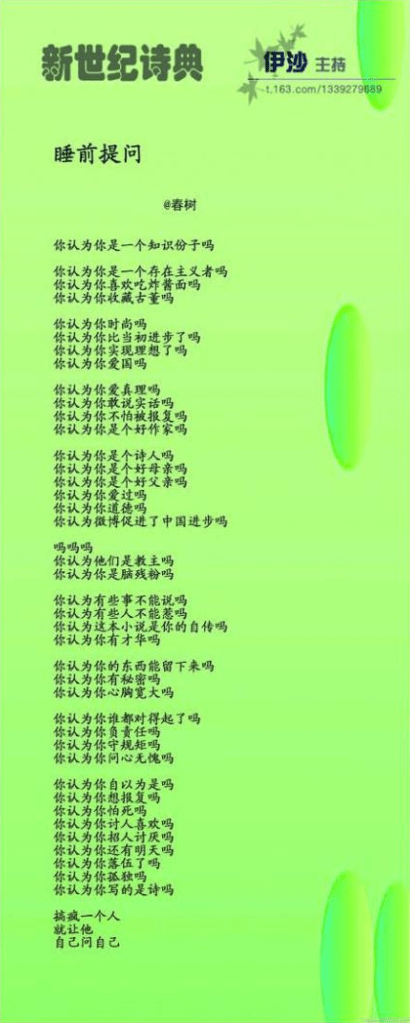
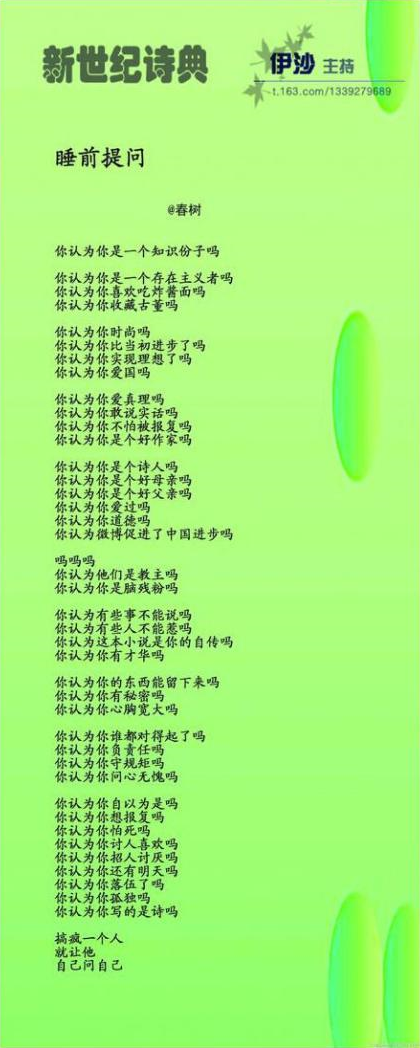
Glaubst du, du bist eine Intellektuelle?
Glaubst du, du bist eine Existenzialistin?
Glaubst du, du magst Zhajiang-Nudeln?
Glaubst du, du sammelst Antiquitäten?
Glaubst du, du gehst mit der Zeit?
Glaubst du, du bist vorwärts gekommen?
Glaubst du, du hast deine Ideale verwirklicht?
Glaubst du, du liebst dein Land?
Glaubst, du liebst die Wahrheit?
Glaubst du, du wagst es, die Wahrheit zu sagen?
Glaubst du, du fürchtest keine Vergeltung?
Glaubst du, du bist eine gute Schriftstellerin?
Glaubst, du bist eine Dichterin?
Glaubst du, du bist eine gute Mutter?
Glaubst du, du bist ein guter Vater?
Glaubst du, du hast schon mal geliebt?
Glaubst du, du hast Anstand?
Glaubst du, Microblogging bringt China voran?
Frage, Frage, Fragezeichen
Glaubst du, man sollte sie anbeten?
Glaubst du, du bist ein Fangirl?
Glaubst du, es gibt Sachen, die darf man nicht sagen?
Glaubst du, manche Leute darf man nicht provozieren?
Glaubst du, deine Romane sind deine Memoiren?
Glaubst du, du bist begabt?
Glaubst du, deine Dinge werden bleiben?
Glaubst du, du hast ein Geheimnis?
Glaubst du, du hast ein großes Herz?
Glaubst du, du bist jedem gerecht geworden?
Glaubst du, du hast Verantwortung übernommen?
Glaubst du, du hast nach den Regeln gehandelt?
Glaubst du, du findest keine Scham in deinem Herzen?
Glaubst du, du hältst dich für unfehlbar?
Glaubst du, du möchtest dich rächen?
Glaubst du, du fürchtest den Tod?
Glaubst du, du kannst sie um den Finger wickeln?
Glaubst du, du wirst ihnen lästig?
Glaubst du, du hast noch ein Morgen?
Glaubst du, du bist schon zurückgeblieben?
Glaubst du, du bist allein?
Glaubst du, was du da schreibst, ist ein Gedicht?
Der Mensch macht einen verrückt
Lass sie sich doch
selber fragen
2012
Übersetzt von Cornelia Travnicek und Martin Winter im Jänner 2015
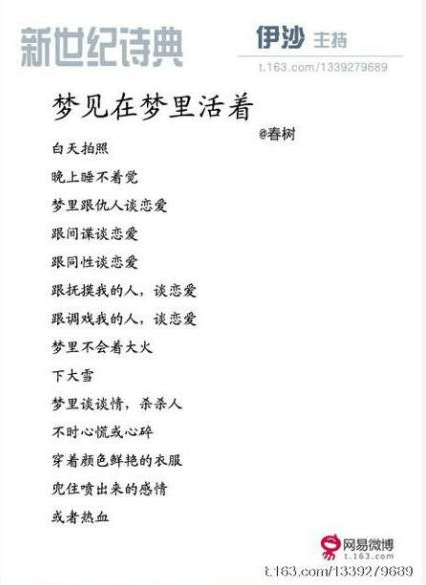
untertags bilder schießen
und nachts schlaflos sein
im traum mit einem feind
von liebe sprechen
mit einem spion
mit jemandem gleichen geschlechts
zusammen mit dem, der mich streichelt
zusammen mit dem, der mich grapscht
in einem traum da kann kein großes feuer sein
kein schwerer schnee
gefühle besprechen, menschen morden
manchmal stolpert das herz, manchmal bricht‘s
kleider in schreienden farben tragen
schäumender überschwang
und heißes blut
2012
Übersetzt von Cornelia Travnicek & Martin Winter im Jänner 2015
Chun Sue
DREAMING OF LIVING INSIDE A DREAM
taking pictures by day
then sleepless at night
in a dream with a foe
talking love
with a spy
talking love
in a dream, same-sex love
in a dream with the one who caressed me
in a dream with the one who harassed me
talking love, can’t be no big fire
can’t be no great snow
in a dream, making love, shoot to kill
panicking, heart-broken
showing colourful clothes
going round gushing feelings
or gushing blood
2012
Tr. MW, 2014-2015
Chun Sue MORGENS ÜBER DIE CHANG‘AN-STRASSE
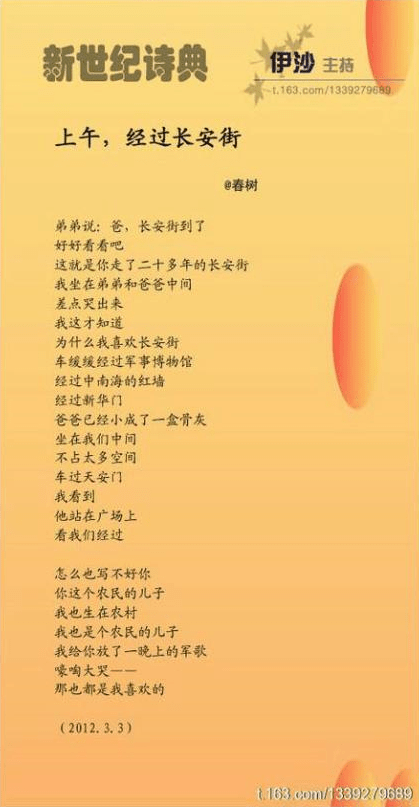
Mein kleiner Bruder sagt: Vater, wir sind auf der Chang’an
schau sie dir gut an
Das ist genau die Chang‘an, die du über zwanzig Jahre lang gegangen bist
Ich sitze beim Vater, beim kleinen Bruder
Fast beginn ich zu weinen
Jetzt erst weiß ich
warum ich diese Straße des ewigen Friedens mag
Langsam, langsam fährt das Auto am Militärmuseum vorbei
an den roten Mauern von Zhongnanhai
am Xinhuamen
Papa ist klein jetzt, er ist eine Urne
die steht zwischen uns
die braucht nicht viel Platz
Das Auto fährt am Tian’anmen vorbei
und ich sehe
wie er auf dem Platz steht
und uns zusieht, wie wir vorbei fahren
Wie soll ich nur über dich schreiben
Du Sohn eines Bauern
Auch ich bin in einem Dorf geboren
Auch ich bin das Kind eines Bauern
Ich lege für dich eine Nacht lang Armeelieder auf
schluchzend und schreiend –
das mag ich auch.
2012
Übersetzt von Cornelia Travnicek & Martin Winter im Jänner 2015
I n-need t-to b-b-break out
f-f-from y-y-your s-sp-pout-ting s-song
b-break o-out o-of y-your h-house
m-m-my sh-shoot-t-ting t-t-tongue
m-m-mach-chine g-g-gunn f-fire
it feels so good
i-in m-m-my s-st-tut-t-ter-ring l-life
the-there a-are n-no g-ghosts
ju-just l-llook at-t m-my f-face
I d-d-don’t c-care!
1991
Tr. MW, 2015
Yi Sha 《结结巴巴》 ST-STO-TO-TT-TERN
m-mein st-sto-to-tt-ternd-der m-mund
b-b-behind-dderter schschlund
b-b-bei-sst- s-ich wund
an m-meinem r-rasenden hirn
und m-meine b-beine –
euer t-trief-fend-der,
schschimmliger schschleim
m-meine l-lunge
i-ist m-müd’ und hin
i-ich w-will r-r-aus
aus eurem g-gross-a-artiggen rh-rhythmus
a-aus eurem h-haus
m-m-meine
sch-schp-prache
m-masch-schinengewehr-s-salven
es tut so gut
in m-meinem st-stott-ttoterndem r-reim
auf m-mein l-leben g-gibt es k-keine l-leich-chen
s-s-seht m-mich a-an
m-m-mir i-ist all-les g-gleich!
1991
Übersetzt von MW im April 2013
<結結巴巴>
結結巴巴我的嘴
二二二等殘廢
咬不住我狂狂狂奔的思維
還有我的腿
你們四處流流流淌的口水
散著霉味
我我我的肺
多麼勞累
我要突突突圍
你們莫莫莫名其妙
的節奏
急待突圍
我我我的
我的機槍點點點射般
的語言
充滿快慰
結結巴巴我的命
我的命裡沒沒沒有鬼
你們瞧瞧瞧我
一臉無所謂
1991
Photos and videos by Beate Maria Wörz
Yi Sha 《精神病患者》 GEISTESKRANKE
theoretisch
weiß ich nicht
wie es sich äußert
wenn eine geisteskrankheit ausbricht
ich hab nur gesehen
in diesem land
in dieser stadt
wenn ein geisteskranker loslegt
streckt er den arm hoch und bricht aus
in parolen
der revolution
theoretically
I don’t know
how it should be
when a mental patient
suffers an outbreak
but what I have seen
in this country
in this city –
a mental patient suffers an outbreak:
up goes his arm
out come the slogans of revolution
1994
Tr. MW, 2013-2014
Photos and videos by Beate Maria Wörz
Yi Sha 《我想杀人》 ICH MÖCHTE JEMANDEN UMBRINGEN
ich fühle mich etwas komisch
ich will jemanden töten
oh! das war letztes jahr
herbst kroch über das laub
zwanzig todeskandidaten
am flussufer nördlich der stadt
“peng! peng!”
einer wurde aufgeschnitten
in der folgenden operation
erhielten WIR eine niere
I am feeling a little strange
– I want to kill someone
Oh! It was last year
autumn crept over the leaves
twenty death candidates lined up
at the river north of the city
„Peng! peng!“
One of them was cut open
and in the following operation
We got a kidney
1994
Tr. MW, 2015
Yi Sha 《9/11心理报告》 9/11 AUF DER COUCH
erste sekunde mund offen scheunentor
zweite sekunde stumm wie ein holzhuhn
dritte sekunde das ist nicht wahr
vierte sekunde kein zweifel mehr da
fünfte sekunde das brennt nicht schlecht
sechste sekunde geschieht ihnen recht
siebte sekunde das ist die rache
achte sekunde sie verstehen ihre sache
neunte sekunde die sind sehr fromm
zehnte sekunde bis ich drauf komm
meine schwester
wohnt in new york
wo ist das telefon
bitte ein ferngespräch
komme nicht durch
spring zum computer
bitte ins internet
email ans mädl
zitternde finger
wo sind die tasten
mädl, schwester!
lebst du noch?
in sorge, dein bruder!
2001
Übersetzt 2013 von Martin Winter
Yi Sha 9.11 REPORT FROM THE COUCH
Ist second: mouth barn-door open
2nd second: wooden-chicken stiff
3rd second: couldn’t believe it
4th second: it must be true
5th second: what a great fire
6th second: well they deserve it
7th second: this is retribution
8th second: these buggers have guts
9th second: must be their religion
10th second: before I realize
my own little sister
lives in new york
I need a telephone
long distance call!
can’t get a connection!
I go storming for a computer
where is the internet
typing out characters
writing an email
shaky fingers
“sister, sister!
are you alive?
your elder brother is worried sick!”
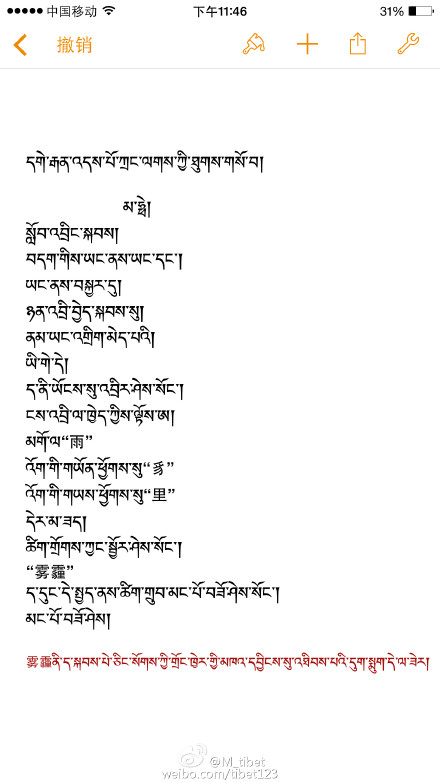
Ma Fei A CONSOLATION FOR THE LATE MR. ZHANG, MY FORMER TEACHER
In junior high,
there was a character,
I wrote it wrong
again and again,
every time
we had a dictation.
Now I can write it,
I’ll write it for you:
“rain” on the top,
“worms” down at the left,
as in “insects and worms”.
“Inside” at the right,
like “outside and inside”.
I can write it correctly
and make a phrase:
“fog-like haze”.
I can make sentences with “haze”,
many sentences.
Tr. MW, April 2015
Ma Fei FÜR HERRN LEHRER ZHANG IM HIMMEL ZUM TROST
in der mittelschule
gab es ein zeichen,
das schrieb ich immer falsch.
immer wieder,
jedesmal
beim diktat.
aber jetzt kann ich es schreiben.
ich schreib es dir vor:
oben kommt “regen”,
unten links “würmer”,
wie “insekten und würmer”.
unten rechts “innen”,
wie in “außen und innen”.
und nicht nur das,
ich kann das zeichen gebrauchen:
dunstglocke.
ich kann auch sätze mit “dunst” bilden,
ganz viele sätze.
im antiseptischen
flughafen: eine frau
hält ein schild: “papa”
MW 2015-03-12
标牌
维也纳
等中国来的飞机
消毒的机场
年轻的中国妇女
举牌
”PAPA“
2015-03
OMI IST IN DER BUTTERMILCH
Wir sitzen im Zug
Zurück nach Wien
Am Stuhleck sieht man den Lift
Am Semmering liegt auch noch Schnee
3 Dichter im Zug
2 Dichter aus China im Zug nach Wien
Von Graz nach Wien
Ein Frühlingstag
Von Graz nach Bruck
Entlang der Mur
Frisches Brot
Mit Buttermilch
Du bist in der Buttermilch
Meine Kindheit
Ist in der Buttermilch
Deine Wohnung
Ist in der Buttermilch
Leben
Ist in der Buttermilch
18. März 2015
SCHÖN
die sonne ist heute wirklich recht schön
ich kann mir noch aussuchen was ich heut tu
schreib ich halt ein gedicht
ich hab gerade ruth klüger gelesen
sie erzählt von wien
auch in der sprache
ich sitz in der wohnung
warum räum ich nicht auf
wenn ich schon nicht arbeite
sollt ein bisschen schlafen
gedichte ordnen
abschicken
ruth klüger hat zwanghaft gedichte gelernt
von uhland und schiller
als jüdisches kind
die sonne ist heute wirklich recht schön
sobald der regen weg ist
ich seh zum ersten mal einen baum
hör die möwen
oder die krähen
ich ich ich
warum schreibt man ein gedicht?
man erholt sich halt wie man kann
after my son wrote his first poem
after I went through six poems
he wrote in one month
with the most critical eye
I think I could muster
when I firmly believed
he had what it takes
I sighed with relief
raised my head
discovered this world
had improved very much
in this very moment
I lost my anger, my fighting spirit
no angry words deep down in my heart
I was loosing my balance
stretched out my hands
for something to grab
something to hold onto
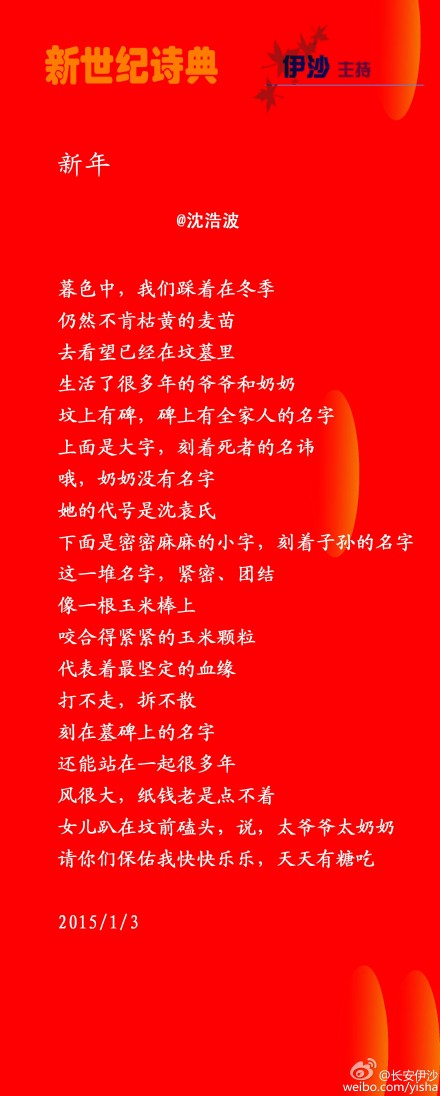
im abendlicht treten wir auf weizensprossen
die sind im winter auch noch nicht gelb
oma und opa gehen wir besuchen,
wohnen schon viele jahre im grab.
am grab ist ein grabstein, der stein hat die namen der ganzen familie.
oben die großen zeichen sind liebe toten
oh, oma hat keinen eigenen namen
sie heißt einfach shen, geborene yuan
unten sind ganz viele ganz kleine zeichen, das sind die enkel
ein haufen namen, ganz dicht beisammen
wie korn an korn verzahnt ineinander
auf einem maiskolben
die stärkste art von blutsverbindung
nicht zu vertreiben, nicht zu zerstören
all die namen auf dem grabstein
stehen zusammen noch viele jahre
der wind ist stark, das totengeld brennt immer schlecht
vor dem grab kniet meine tochter. “uropa, uroma!
bitte beschützt mich, macht mich ganz ganz froh, jeden tag hab ich zuckerl!”
people’s names on the boards at arrivals
written in english
or in chinese
written in arabic script
at international arrivals, leaning against the railing
in the corridor along the exit
people are swarming
some of the names carried off by a smile or a hug
some of the names haven’t arrived at being carried off
they are waiting together
becoming familiar
some even looking in one direction
standing next to each other
beginning to talk
breathe, 呼吸 (hu-xi) 开关 (kai-guan) 外内 (wai-nei) open-close out-in breathe 呼吸 what thing 啥事 (sha shi) what the thing 啥呼吸 (sha huxi) what breathe 啥写作 (sha xiezuo) what writing what make up 傻创作 (sha chuangzuo) 作弄 (zuo nong) 打坐 (da zuo) hit sit 装作 (zhuang zuo)
make believe 装作 make up 装冷 (zhuang leng) you’re cold 装热 (zhuang re) you’re hot 发作 (fazuo) break out listen 聆听 (lingting) 等 (deng) wait
给你看 (gei ni kan)
给你听 (gei ni ting)
给你弄 (gei ni nong)
任你想 (ren ni xiang)
4 u please see please hear do your thing think whatever 打坐 吐纳 (tu-na) hit sit in out breathe
呼吸 old new 啥打坐 啥静坐 (sha jing-zuo) meditation 坐禅 (zuo chan) sit-in
occupy central
佔中
走神 (zou shen)
dichten, offen werden, zu atmen, liegen atmen, stehen atmen, sitzen atmen, gehen laufen, sehen atmen, still atmen, stillen atmen, durst atmen, hören atmen, ohr atem schöpfen atem, ein atem, aus atem, warten atem, kommen atem, hör atem, auf atem, fang atem, ball atem, dich
mind is a most wonderful word
make up, open coming, close breathe in, listen breathe in, out breathe in, lying breathe in, down breathe in, sit breathe in, stand breath in, walk running, see breathe in, still nursing, thirst breathe in, hear breathe in, ear take your breath take your width breathe, in breathe, out breathe, wait breathe, come breathe, stop catch breath run, low catch, throw breathe, curl breathe, up breathe, your breathe, thing breathe, make breathe, make up breathe, open breathe, close breathe, close to breathe, body breathe, fear breathe, pain breathe, make up breathe, clothes breathe, colors breathe, white breathe, contact breathe, spar breath, no breath, words breathe, open breathe, clothes come again come loose come win me make up make shut atem make contact atem remember, atem breathe, 呼吸,开关,外内 open-close out-in breathe, 呼吸 what thing 啥事 what the thing 啥呼吸 what breathe 啥写作 what writing what make up 傻创作,作弄,打坐 hit sit 装作 make believe 装作 make up 装冷 you’re cold 装热 you’re hot 发作 break out listen 聆听, 等 wait
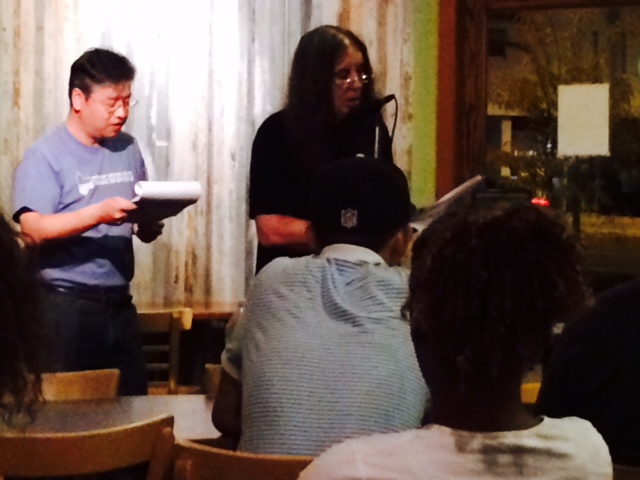
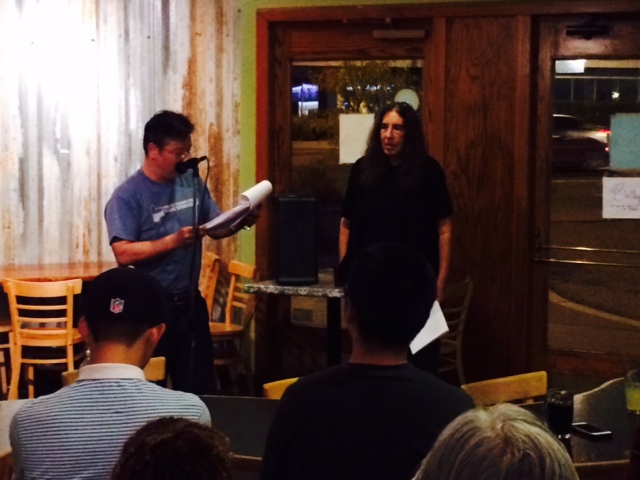
Presented by Tucson Poet Laureate Rebecca Seiferle!
Bentley’s House of Coffee and Tea, 6-8 pm
photo by Michael Gessner
4
Yi Sha SEX EDUCATION
One of our travels
We didn’t get out very much –
Nine years ago. Led us to Qingdao –
A summer of love
Sand castles, writing on rocks
Fresh clams in small restaurants
Very cheap. I remember
We lived in a school
A hotel for the summer
It was our summer of
Watching movies together
One night we sat
In the video room
All the way until morning
There was a flick about all kinds of fish
We were attracted
And then we felt
Shaken without compare
There was a fish called salmon
They had this one time
Of uninhibited communion
At the end of their lives
Fish of great beauty
Nine years ago
We don’t remember
How great it was
But no-one forgets
The pain at the end
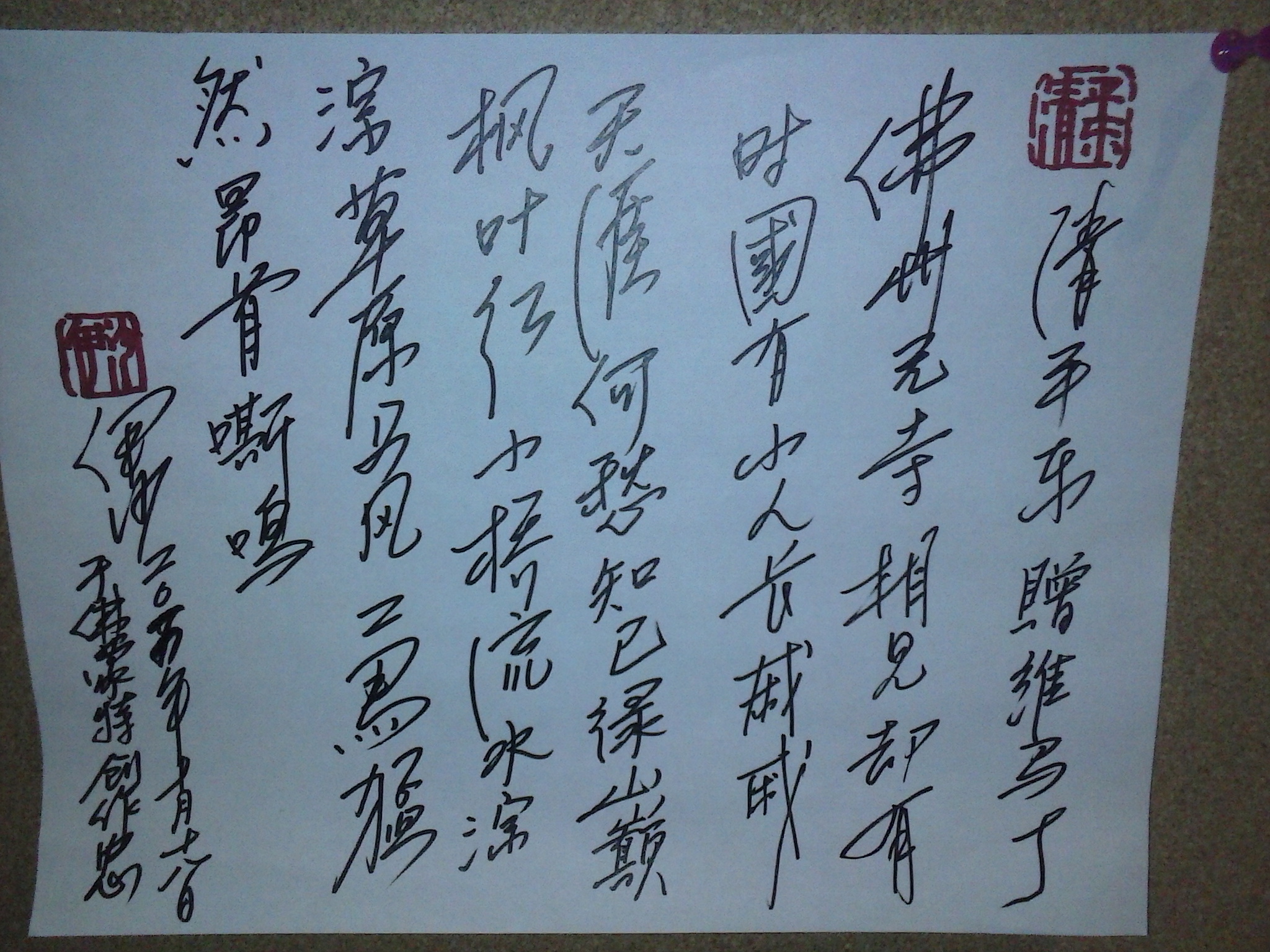
Yi Sha Song dynasty lyrics: Qing Ping Yue
for Martin
Frost state has no temples,
but there are times to see each other.
In my country, small people keep chirping.
Beyond the skies I am finding my friends,
red maple leaves on the trails in green hills,
streams keep on flowing.
Two people born in the year of the horse:
We raise our heads, go like the wind.
Written 10/16/14 at Vermont Studio Center
Tr. MW, Oct. 2014
Yi Sha SONG OF VERMONT
(Tang dynasty style)
Green peaks raise blue skies,
clear brooks meet in ponds.
Maples reflected –
is this the real world?
Wang Wei walked here
to his Journey’s End.
Frost stopped in woods,
we have miles to go.
I am just a guest,
with geese flying south.
Red leaves send us off,
snowflakes greeting spring.
Written 10/16/14 at Vermont Studio Center
Tr. MW, Oct. 2014
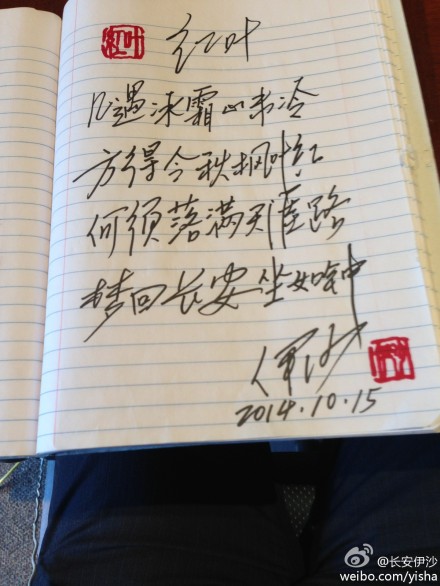
Yi Sha RED LEAVES (Tang dynasty quatrain)
Have met frost, heart’s still warm.
So in this fall I meet red leaves.
Should we cover all the roads?
Like a bell I sit in Chang-An*.
Written 10/15/14 at Vermont Studio Center
Tr. MW, Oct. 2014
*Chang-An: Today called Xi’an, capital of China through 13 dynasties. Yi Sha’s home town.
the night they announced
the lu xun literature prize
my mobile phone rang
it was the ningxia muslim poet
shan yongzhen. he said:
“only if you are never considered
for the biggest official prize,
you can become
a great poet in china.
tonight my first candidate
would have been chang yao
(who died in 2000)
the second one I thought of
was you, brother yi!”
hearing these words
brother yi stammered
didn’t know what to say
would have liked to hang up
brother shan said:
“so you don’t want to
discuss this topic
in any way?”
I said:
“yes, yes ….”
he didn’t know
what I was doing
I didn’t want to discuss any topic
I was watching a porn flick
on my computer
there was this great
piece of ass from thailand
in front of my eyes
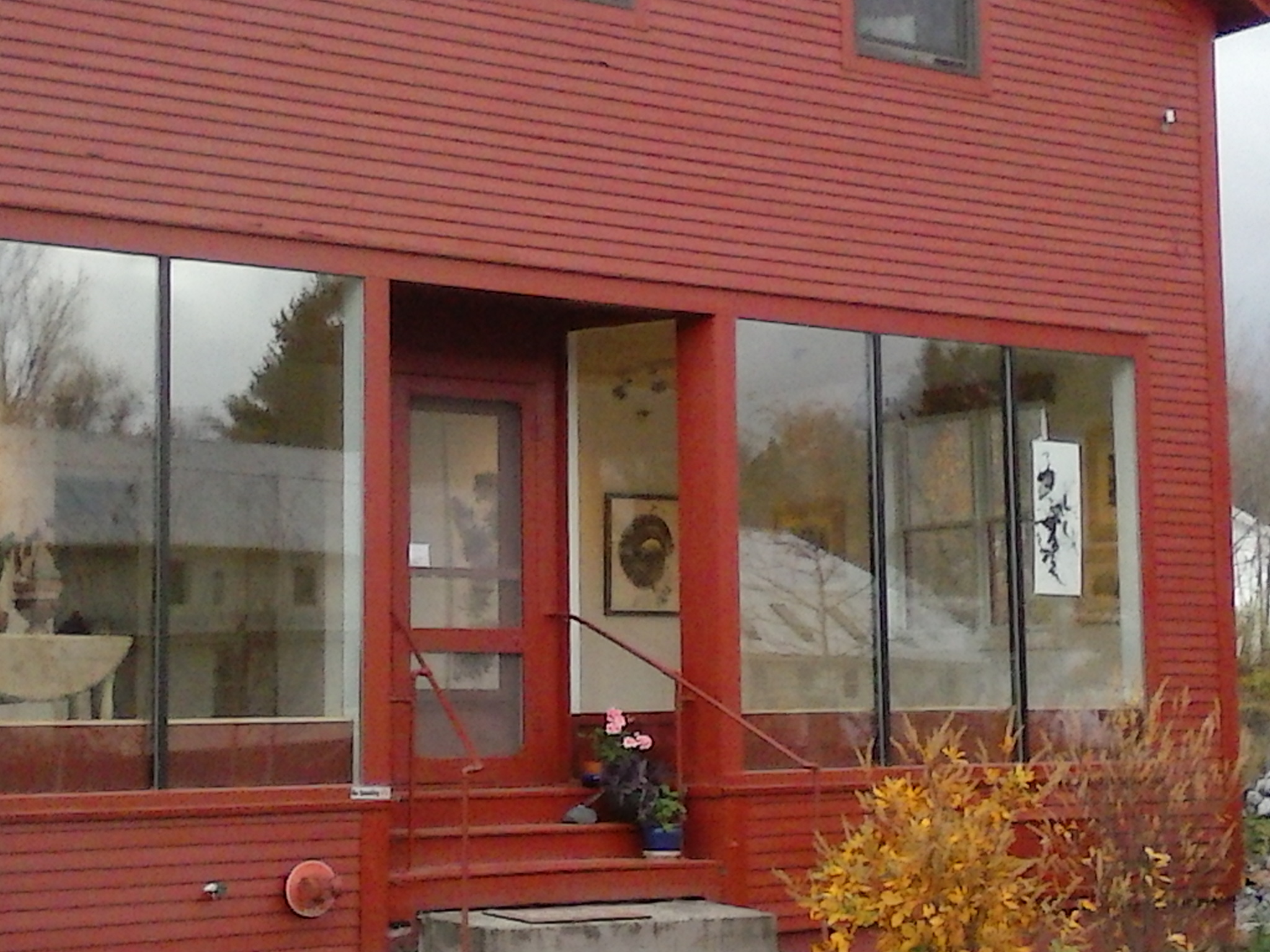
at vermont studio center
in front of maverick writing studio
I ask joann
the female writer from chicago:
“I heard the longest residence here
is twelve months.
have you met any writer or painter
who stayed that long?”
“yeah, I’ve seen one”, says joann
stretching both arms in front of her
hopping forward
at the hospital waiting in line
to pay for registration
suddenly he tells me
he wants to go to the bathroom
I let him stand in line
while I go to ask at the counter
then I come back to tell him
go to the second floor, take a left then go straight
it is on the right side
when you keep to the right you can see it
after a while he comes back
all confused.
“I couldn’t find it,
you know I can’t read
everywhere they’re waiting in line
and I didn’t smell
anything like a toilet!”
they scurry across like wandering souls at the train station
at the machines the industrial zone squalid rented rooms
their thin female bodies like knifeblades like paper
hair fibres air their fingers cut
iron plastic film etc they’re numb and exhausted
like wandering souls packed into machine tables
work clothes assembly lines their glowing eyes
in the bloom of their youth scurrying into the shadowy stream
they created themselves I can’t tell them apart
I am standing among them no one knows who I am a sack of skin
limbs movement vague expressions one harmless
face after another they are always assembled lined up
forming electronics factory anthill toy factory beehive females
smiling standing running bending curling
each simplified into one pair of hands thies
fastened screws cut iron sheets
compressed plastic curved aluminum cut fabric
their frustrated satisfied weary happy
tangled up helpless lonely expressions
they come from villages hamlets valleys teams they’re intelligent
awkward they are weak timid
today they are kneeling before the shining glass windows doors
black-clad security polished limousines green tangerines
gold-emblazoned factory name shining in sunlight
kneeling at the factory gate holding up a cardboard sign
awkward charakters “give us sweat-and-blood-money”
they look quite fearless as they kneel at the factory gate
surrounded by a crowd days ago they were colleagues
from the same province friends coworkers above or below
women without any expression watching four kneeling women workers
watching four colleagues dragged away by security watching
one of the four losing a shoe watching another worker
getting her pants torn in the struggle silently watching
four kneeling women dragged far away in their eyes
there is no sadness no joy without any expression entering the factory
their tragedy leaving me sad or depressed
du you think you are an existentialist?
do you think you like to eat zha jiang mian?
do you think you are collecting antiques?
do you think you are following fashion?
do you think you have improved since you started?
do you think you have fulfilled your ideals?
do you think you’re a patriot?
do you think you love the truth?
do you think you dare to say it?
do you think you don’t fear retribution?
do you think you’re a good writer?
do you think you’re a poet?
do you think you’re a good mother?
do you think you’re a good father?
do you think you have loved?
do you think you are moral?
do you think microblogging makes China improve?
question mark mark mark
do you think they are prophets?
do you think you’re a groupie?
do you think there are things you don’t talk about?
do you think there are people you cannot offend?
do you think this novel is your autobiography?
do you think you have talent?
do you think your stuff is going to last?
do you think you have secrets?
do you think you have a big heart?
do you think you are fair to everyone?
do you think you’re responsible?
do you think you play by the rules?
do you think you have nothing to be ashamed of?
do you think you are self-important?
do you think you want revenge?
do you think you are scared of dying?
do you think you make people like you?
do you think you make people hate you?
do you think you have a future?
do you think you are falling behind?
do you think you are lonely?
do you think you are writing a poem?
this girl makes you crazy
let her go on babbling
asking herself
Tr. MW, June 2014
Chun Sue DREAMING OF LIVING INSIDE A DREAM
Tr. MW, June 2014
Published in EPIPHANY magazine, fall 2014. Go on, look for this great Chinese Dream! I spent October 2014 at Vermont Studio Center with Yi Sha, editor of the daily New Century Poetry series 新世纪诗典. Chun Sue is one of the most well-known figures within this huge independent circle of poets.
Chun Sue MORNING, AVENUE OF ETERNAL PEACE
Little Brother says: dad, Avenue of Eternal Peace
take a good look
This is the road you walked for over 20 years
I am sitting with Papa and Little Brother
I am almost crying
Finally I know
why I like the Avenue of Eternal Peace
Slowly the car passes the Military Museum
and the red walls of Zhongnanhai
and Xinhua Gate
Papa is small now he fits in an ash box
sitting between us
doesn’t take up much space
We pass the Gate of Heavenly Peace
and I see him
He stands on the square
watching us while we’re passing
Why was it so hard to write about you
You’re the son of a peasant
I was born in a village
I am also the child of a peasant
I put on army songs for you all night
Crying my heart out —
I like all that too.
In the summer of 1992, in a vegetable garden on the roof of a shed housing inmates of the Sichuan Province Prison # 1, I spent three days alone with the old prisoner Zhang Fafu, who had been transferred to this prison at Nanchong from forced labor at a coal mine. Our task was to build a wall out of plastic parts and wire at the side where the roof garden faced the bathing pool, to prevent other prisoners from secretly watching the women taking their baths down below. I got this assignment at that time because my sentence was short, I was working at the kiosk of my unit and wasn’t considered a common criminal. So the cadre chose that old prisoner from the coal mine and me.
From the second day on he told me everything about himself. From his talking, I could feel the jolts in his soul. He had attended high school before Liberation in 1949, he loved reading and understood a lot of things; he even liked poetry. He asked me so often until I had no choice but to give him one of the poems I had written. A few days later, I was transferred. After I arrived at Prison # 3, someone from # 1 came to go over my accounts. That’s when I heard something happened to Zhang Fafu. He had taken the plastic parts from our wall, tied them to is arms and jumped from a building. He wasn’t dead, but he became a vegetable.
I don’t know if he read my poem. Later, when I was released from Prison # 3 upon completion of my sentence, I stuffed the original manuscript of this poem into a bamboo flute I had got from Liao Yiwu, and blocked the hole at the bottom with soap. This way I got to take the poem with me. All these years, whenever I think of Zhang Fafu, I think of our plastic wall. It’s not the same as the wall in my poem, but now I cannot separate the poem from Zhang Fafu.
Tr. MW, 2013
Translator’s note: Li Bifeng’s NOTE and the following poem (http://wp.me/PczcX-zk) are part of his novel Wings In The Sky (天空中的翅膀). One chapter is available on the LIBIFENG2012 WordPress site. The main characters are an old prisoner, a bird and a woman who lives in a shed not far from the prison with her daughter. The plot is rather interesting.
I am starting to understand the pain in my poems comes from myself
you don’t have the despair and confusion you are accustomed
working overtime sleeping getting paid sending money
going back home every year or two like a clockwork
you are used to the rhythm you came from a village in a different province
you didn’t face the bewildering city the temporary residence permit’s
iniquity didn’t think of putting down roots in the city
weren’t going to ponder anything a little more distant
or resist you are used to “government rules
or everyone does it that way” so they are always right
all those years being best friends but you could never
comprehend my anger and I could never understand
how you swallowed it all and kept silent “to dream is the greatest right of the age”
and exactly the opposite “why would you dream of anything unrealistic”
facing reality coming from the countryside I feel so
futile and helpless inappropriate alone sometimes
“life is about getting through every day” you tell me
we talk about outfits the weather distant Sichuan
or how we are going to go far in the factory
defective products. staying close to the factory’s wages… life
being used to repeat every day twenty-four hours
sixty minutes per hour this is life finding
work in the fields in the factory getting married giving birth
raising kids getting old like your parents your whole life
you never lose which means you never win it remains
to keep alive keep it simple breaking up endless repetitive
life being dull or pure I think of these words
and of your smile actually your life is getting less
peaceful worrying your husband far away
could he get out of hand and your kids might
obey less and less and your burden grows heavier
wearing you down sometimes you sit at the window
silent alone brooding
moments nobody notices
Leben in täglichen Kleinigkeiten. Voller Rußgeruch.
Gewalt und Denken als zufällige Gewürze.
Die Gewalt des Beraubtwerdens hast du vergessen. Ich müh’ mich
Noch ab unterm Schatten des Denkens. Du sagst jedesmal
Das Leben mache dich viel zu müde. “Warum noch an diese Dinge denken”,
“Man kann ja doch nichts ändern. Die Realität macht nur Kopfschmerzen.”
Genau. In dieser gleichgültigen Welt. Sind wir
Winzig und schwach. All die Jahre. Hat jemand gelesen
Den Zorn und die Trauer in meinen Gedichten. Mir setzt man
Einen seltsamen Hut auf. Über das Denken und die Politik
Hab ich mir nie Gedanken gemacht. Aber zur Gerechtigkeit,
Ich kann nicht tatenlos zusehen. Es muss Aussichten geben.
Du beschwerst dich über mittlere Kader in der Fabrik.
Manchmal sind sie korrupt….Aber am Ende
Seufzt du immer und sagst: “Leider wissen ihre Vorgesetzten
Nichts davon. Sonst…. Damit wir nicht
Verzweifeln. Machen wir uns über unerreichbare Vorgesetzte
Schöne und gütige Gedanken. Bis irgendein Chef mit den Geldern durchbrennt
und dir noch drei Monate schuldet, dann bist du baff. Egal ob
Wir beraubt oder betrogen wurden. Wir stehen der Welt gegenüber
Voller Begeisterung und Vertrauen. Von Anhui bis Dongguan. Ganze sechs Jahre
Hast du lauter Fabriken gewechselt. Von Dongkeng bis Changping. Und Huangjiang
Wir waren nicht weit voneinander getrennt. Dein blinkendes Logo, wir haben gechattet,
Du hast mir dauernd etwas erzählt.
Dass die Fabrik bankrott ging. Dass die Bestellungen verschwanden.
Du hast mir erzählt, dass dein Chef, wegen der Wirtschaftskrise
Jeden Tag buckliger aussah. Du sagtest, als du ihn sahst,
Standest du deinem Vater gegenüber, im Feld nach der Missernte.
how far is the mouth from the tip of the brush?
how far from the tip of the brush is the street?
how far is the street from the court?
how far is the court from the jail?
how far is the jail from the shots?
how far is democracy from the court?
how far is democracy from the jail?
how many light-years away from the shots?
wie weit ist die pinselspitze vom mund?
wie weit von der strasse?
wie weit ist die strasse entfernt vom gericht?
wie weit ist es vom gericht zum gefängnis?
wie weit vom gefängnis zum schuss?
wie weit vom gericht ist die demokratie?
wie weit ist die demokratie vom gefängnis?
und wie viele lichtjahre vom schuss?
300 Modern Chinese Poems (Chinese-English) 汉英对照版《中国新诗300首》
Zhao Siyun 赵思运, who was introduced on the MCLC list by Michael Day a while ago with a poem called June 5th 六月五日, has a list of authors and poems on his Blog, for a Chinese-English anthology of over 300 modern Chinese poems 中国新诗300首. Compiled by an institution called International Poetry Translation and Research Centre, IPTRC. Very welcoming, diverse and expansive. Including writers from Taiwan, and many young voices. Liao Yiwu 廖亦武 is included, though not with his most representative work, probably. Lü Yuan 绿原 is there, he did a Chinese-German anthology, introducing Yu Jian 于坚 in 1990, rather early. Bei Dao 北岛 was included in there, but with a comparatively insignificant poem. He is better represented in this new effort, although I miss the mosquito. It’s very hard to include one or two significant poems from an author who is obviously politically significant.
Interesting to compare this with other anthologies, in Chinese and other languages. Zhongguo Xin Shi 中国新诗 (Fudan UP 2000), ed. Zhang Xinying 张新颖, has two poems by Zhou Zuoren 周作人, one against unnecessary water dams and a drinking song, both very impressive. Zhou Zuoren has not made it onto the IPTRC list. Of course it’s rather easy to come up with some of your favorites who are not represented, compared to shifting through many thousand poems and coming up with such a list. Huang Xiang 黄翔 is included, despite his dissident status, but he is already in Zhongguo Xin Shi 中国新诗. As usual, I am looking at newer people first, although I only recognize two from those born in 1970 or later. Zhou Yunpeng 周云蓬 is there, the blind folk singer. But not Cui Jian 崔健. Woeser 唯色 is there, which is great! But in general there are hardly any poets from minority nations in China.
Ha Jin 哈金 is missing, but he writes in English. Gao Xingjian 高行健 does not appear, but is mostly known for fiction and drama. So who else hasn’t made it? Yang Ze 楊澤、Hsiang Yang 向陽、Hung Hung 鴻鴻、Mai Mang 麦芒 (Huang Yibing 黄亦兵), who sometimes writes in English and teaches at Connecticut (there is another Mai Mang 麦芒 in China, known for one-liners).
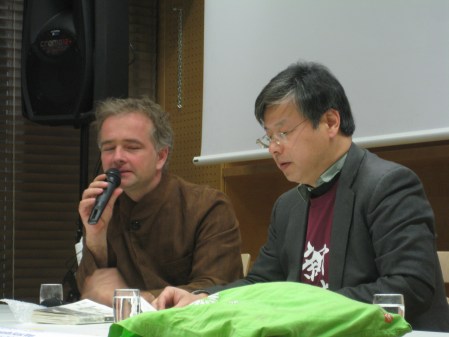
On with the non-list: Sun Wenbo 孙文波、Li Nan 李南、Yang Jian 杨键、Zhu Wen 朱文、Yin Lichuan 尹丽川、Zheng Xiaoqiong 郑小琼、Ma Lan 马兰、Hong Ying 虹影、Pang Pei 庞培、Che Qianzi 车前子、Yan Jun 顏峻. I would have included Yan Jun’s 反对 Against All Organized Deception (translated by Maghiel van Crevel) and Ma Lan’s 事故和理由 The accident and the reason, maybe even combined with 仿佛 As If. And How We Kill a Glove 我们如何杀一只手套, if it wouldn’t be too long. Hong Ying’s 饥饿 Hunger, also written abroad. And one of Zheng Xiaoqiong’s 郑小琼 new female migrant worker’s portraits.
I have been reading a great anthology of Lithuanian poetry in the last few days. And there are beautiful anthologies of recent Chinese poetry in English, like the online treasure in the Spring/Summer 2006 issue of thedrunkenboat.com, edited by Inara Cedrins, or the Atlanta Review China issue. Without any Chinese characters, unfortunately. But these are important collections, with some great translations. The Drunken Boat collection is very diverse, including minority people in China, extra sections on Hong Kong, Macau and Singapore, as well as very much else from abroad. Even half of the non-minority nation poets in China who are in The Drunken Boat are not in the IPTRC 300. The Antlanta Review China collection, edited by George O’Connell, contains some of the best Chinese poetry I’ve read in translation anywhere in any language. And there is a good volume in English of Che Qianzi’s 车前子 poems and some of his friends, with a note in the back that the Chinese text can be found in some university library. Oh well. Many contemporary poets from China, including some world-famous ones, are not easily found in China. This has been going on for decades. Anyway, there is not enough modernity, not enough experiment in Chinese literature in general, especially in China. So it would be great to include some people like Che Qianzi 车前子 in any anthology. There is also not enough performance, that’s where Yan Jun 颜峻 and other sound and music stuff would come in.
The Lithuanian anthology mentioned above is from Poetry Salzburg Press. I love the long hallucinating love poem Bird in Freedom by Vytautas Bložė, written while imprisoned and “treated” in a Soviet psychiatric hospital. And the song-like evocations of Vilnius’ old city and the empty Jewish ghetto by Judita Vaičiūnaitė. The translations of these poems and many others by Laima Sruoginis are hauntingly beautiful. Much of the identity of the Baltic countries is built on songs, a great foundation for poetry.
In 2004/2005 or so in Beijing, my wife and I became friends with some parents of other kids at the local kindergarten. One mother had studied art in Japan and introduced me to blogging. Since early 2008 I have a website at Yahoo Japan. (I had spent a few weeks in Japan in early 1993, on a boat trip from Shanghai.) There is a blog I maintain at Langmates (translation and localization), another one for poems only (almost) and a harmonized teaser, among others. My translations of poems and various signs and banners in China can also be found on websites set up by Sam Brier (2004) and by Charles Laughlin (Ma Lan’s poetry). MCLC (Modern Chinese Literature and Culture), edited by Kirk Denton, has not only spawned an extensive treasure trove of Modern Chinese Literature and Culture sources, but also an Email-list server which has maintained professional and other exchange services for the international Chinese Studies community and beyond, including some very lively discussions. Recently, list members have introduced their blogs, such as Anne Henochowicz, Andrew Field, Jeanne Boden and Charles Laughlin. The initiative was started by Paul Manfredi.
Liu Xiaobo, the Chinese dissident sentenced to 11 years on Dec.25th 2009 for “incitingsubversion“, was awarded the Nobel Peace prize in absentia in Oslo on Dec. 10th, 2010. Liu’s old friend and Independent Chinese PEN co-founder Bei Ling has written a biography of Liu Xiaobo. Bei Ling started off from an essay he wrote in June 1989 in New York, after Liu Xiaobo had been arrested in Beijing in the aftermath of the massacre throughout the city, as People’s Liberation Army troops forced their way through the streets blocked by protesters in the last phase of the demonstrations on Tian’anmen Square. Liu Xiaobo had returned to China from New York and led a hunger strike of intellectuals on the square, supporting the students and Beijing residents in their demands for civil liberties. Bei Ling‘s essay from 1989 was re-published in Chinese in Hongkong and Taiwan in June 2009, and in the German newspaper FAZ on October 12th, 2010, a few days after the Nobel Peace prize announcement from Oslo. Soon after, the German publisher Riva expressed interest in a biography of Liu. Bei Ling had recently written a literary memoir of his years a Beijing underground poet in the 1980s and a literary magazine editor, shuttling between China and foreign countries, in the 1990s. Liu Xiaobo and other old friends such as Liao Yiwu are important figures in Bei Ling’s memoir, to be published by Suhrkamp in Germany this year. So Bei Ling was ready to write his biography of Liu Xiaobo on short notice. It was a crazy idea, but it worked. We worked around the clock in November 2010, and in early December the book hit the shelves. In the first week, from Dec. 9 to 16, it sold 2500 volumes, according to the publisher. Since then, Bei Ling’s biography of Liu Xiaobo has been reviewed in many newspapers, magazines, on TV and radio stations etc. throughout Germany and in neighbouring countries. This month (January 2011), according to the publisher, the book has started to appear on the Spiegel magazine’s bestseller list, the standard list in the German-speaking realm. On January 11th, 2011, a symposion with Bei Ling, Prof. Weigelin-Schwiedrzik, Prof. Findeisen, Prof. Zhu Jiaming, Dr. Felix Wemheuer and others was held at Vienna University and met with great interest among students and teachers from various faculties. Seehere …
Liu Xiaobo biographer Bei Ling at Vienna University on Jan. 11th, 2011. Photo: Angelika Burgsteiner

















 中国大好き
中国大好き 